Log in


AI summary
Overview The article reviews how content delivery networks have evolved by 2026 into platforms that combine delivery, compute, and security capabilities, and how decisions about CDNs are now driven by cost control, resilience, protocol modernization, and the capacity of origin infrastructure.
Trend — Multi‑CDN as standard Using multiple CDN providers has shifted from a contingency strategy to a common architecture. Active‑active deployments that keep caches warm across providers reduce origin overload during failover, which elevates origin capacity and connectivity as integral parts of delivery design.
Trend — HTTP/3 and QUIC adoption New transport-layer approaches have moved from experimental to expected. By decoupling streams and embedding the security handshake, these protocols improve performance on lossy or mobile connections and change vendor differentiation to metrics like resumption and connection migration.
Trend — Regional pricing and cost predictability Wholesale bandwidth costs have declined unevenly across regions, while commercial rate structures still vary by geography. As audience mix shifts, regional rate differences can raise blended unit costs, making globally consistent pricing and progressive volume tiers important for predictable billing.
Implications for high‑bandwidth platforms Platform operators should prioritize resilient, distributed delivery architectures; measure end‑to‑end performance including cache effectiveness and origin response; select pricing models that limit regional cost volatility; and treat CDN and origin as a unified system to avoid bottlenecks and opaque cost drivers.
Bottom line Effective delivery in the current landscape requires architectures that combine active resilience, modern transport protocols, transparent pricing, and coordinated origin capacity so that performance scales without introducing unpredictable cost or single points of failure.
What is actually changing in content delivery, edge infrastructure, and CDN security?
In 2026, content delivery networks have become security platforms, compute environments, and the primary deployment vehicles for next-generation web protocols, and the most important trends center on cost control, delivery resilience, protocol modernization, and the growing importance of origin infrastructure in determining total delivery cost.
This article covers the three trends shaping CDN decisions for streaming platforms, iGaming infrastructure, and bandwidth-intensive applications.
The state of the CDN market in 2026
More than 75% of global internet traffic is now delivered via CDN infrastructure, with video streaming accounting for roughly 65% of CDN bandwidth consumption. Over 8,500 CDN edge locations are operational worldwide, and the top providers control about 62% of the combined market share, while more than 120 smaller providers compete across regional and niche segments.
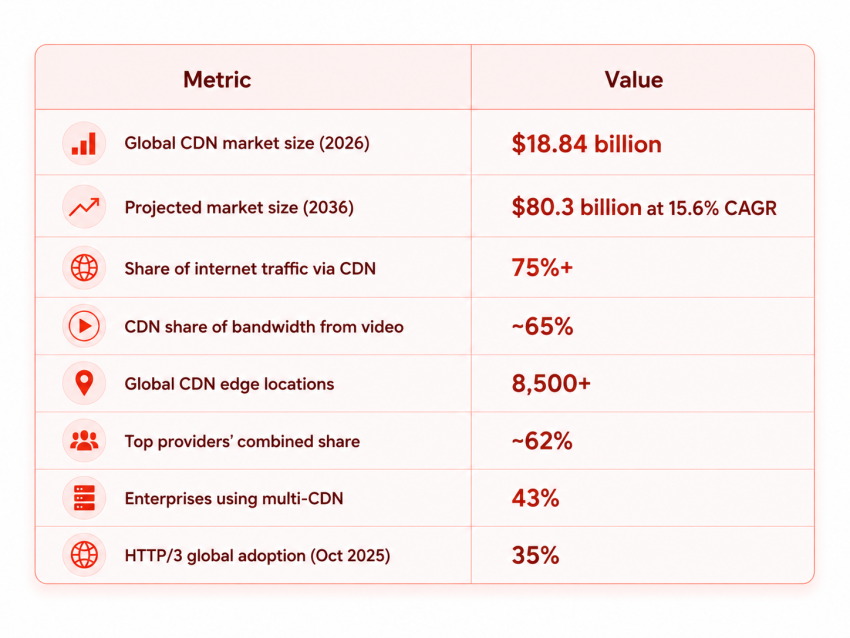
That growth and consolidation at the top explain the first shift worth examining: how enterprises are restructuring their CDN setups.
Trend 01: Multi-CDN moves from contingency plan to standard architecture
Multi-CDN is now a standard architecture for enterprise content delivery. 43% of enterprises already run diversified CDN setups, and that number grew sharply after November 2025, when a Cloudflare outage disrupted roughly 20% of global websites and caused losses estimated in the hundreds of millions of dollars. A single provider taking down a fifth of the internet in one incident is a stronger business case for multi-CDN than any analyst report.
But the architecture matters as much as the decision to adopt it. A passive multi-CDN setup where a backup CDN sits idle until the primary fails has a dangerous failure mode. When traffic shifts suddenly to a CDN with a cold cache, every viewer request immediately reaches the origin. That can overwhelm origin infrastructure at the exact moment the edge is already in trouble.
The active-active multi-CDN model keeps traffic distributed across providers continuously, so caches stay warm on all networks and any provider can absorb a full traffic shift without hitting the origin. Orchestration platforms have made active-active multi-CDN possible for teams that do not have large network engineering departments.
Multi-CDN changes the relationship between CDN and origin. In a single-CDN setup, the origin has one upstream. In an active-active multi-CDN setup, the origin must be capable of serving cache fills from multiple CDN providers simultaneously without becoming the bottleneck during a traffic shift. This makes origin infrastructure (i.e., hardware, bandwidth capacity, and connection headroom) a critical part of the multi-CDN architecture.
Protect your content and control delivery costs with infrastructure built for high-volume streaming
Trend 02: HTTP/3 and QUIC cross from emerging standard to table stakes
HTTP/3 reached 35% global adoption as of October 2025. Among the top 1,000 sites by traffic, adoption is already above 50%. HTTP/3 is not a future-looking protocol anymore.
To understand what HTTP/3 fixes, it helps to understand what was broken in HTTP/2. HTTP/2 lets multiple requests travel in parallel. That solved the serialization problem at the application layer. But this model has a peculiar problem: if one packet is lost, all subsequent packets wait for retransmission, regardless of which request they belong to. In high-packet-loss conditions such as congested connections, this can make HTTP/2 perform worse than HTTP/1.1.
HTTP/3 replaces its native transmission control protocol (TCP) with QUIC, a transport protocol that runs over UDP. Each QUIC stream handles packet loss independently. A dropped packet on one request does not touch the others. The improvement is most pronounced for mobile audiences, international users, and anyone on a last-mile connection that loses packets. Benchmarks show HTTP/3 response time improvements of around 47% versus HTTP/1.1 in realistic conditions with packet loss.
QUIC also integrates TLS 1.3 at the transport layer, combining the connection and security handshakes into a single round trip instead of the two to three round trips required for TCP with TLS. And QUIC uses a connection ID rather than the traditional four-tuple (source IP, source port, destination IP, destination port) to identify sessions. That means a user switching from Wi-Fi to cellular keeps their connection instead of triggering a full re-handshake. For mobile streaming, that matters.
In Q1 2026 CDN benchmarks, HTTP/3 support is table stakes among the top providers. The competitive gap has moved to how well each provider handles 0-RTT resumption and connection migration on mobile networks.
Trend 03: Regional CDN pricing is making global growth harder to predict
The underlying cost of moving internet traffic continues to decline. TeleGeography reports that weighted median 100 GigE IP transit prices across the markets it tracks fell by 12% annually between the second quarter of 2022 and the second quarter of 2025. In the most competitive hubs, the lowest available rates remained at approximately $0.05 per Mbps per month.
However, lower wholesale bandwidth costs do not translate into the same savings for every CDN customer. The commercial model still determines what appears on the bill. Some CDN rate cards vary by both traffic volume and delivery region, meaning the same terabyte can cost substantially more when delivered to South America, Asia, Oceania, the Middle East, or Africa than to Europe or North America.
This becomes increasingly important as platforms expand internationally. A company may be able to forecast its total traffic reasonably well, but not exactly where that traffic will come from each month. A successful launch, new content partnership, or sudden audience shift can move a larger share of delivery into a more expensive region. Total traffic may remain within budget while the blended cost per terabyte rises.
A globally consistent pricing model separates these two variables. Traffic delivered from any location follows the same worldwide rate card, regardless of where the viewer is located, while progressive volume tiers reduce the price applied to successive traffic bands as monthly usage grows. This allows customers to benefit from scale without introducing additional cost uncertainty as their geographic reach expands.
Scale internationally with consistent worldwide pricing and progressive volume tiers
What do these trends mean for high-bandwidth platforms?
Streaming services, iGaming platforms, and content distributors moving hundreds of terabytes each month should evaluate CDN decisions across four areas:
- Design for delivery resilience.
Avoid architectures that depend on a single server, location, or traffic path. Look for distributed points of presence, continuous health checks, intelligent traffic steering, load balancing, and failover mechanisms that can redirect requests when infrastructure becomes unavailable. - Assess performance across the complete delivery path.
HTTP/3 support at the edge is valuable, but it should not be evaluated in isolation. Monitoring should also cover cache-hit rates, startup time, rebuffering, origin response, and the protocols used between the edge and origin. The objective is consistent viewer performance, not simply checking a protocol box. - Choose pricing that remains predictable as audiences move.
Traffic volumes and geographic distribution can change quickly following a launch, live event, or expansion into a new market. A worldwide rate card with progressive volume pricing allows unit costs to decline as usage grows without introducing regional surcharges when more viewers come from traditionally expensive delivery markets. - Treat the CDN and origin as one infrastructure system.
As traffic scales, CDN performance increasingly depends on the infrastructure behind it. Dedicated origin capacity, predictable bandwidth, efficient caching, modern compression, and direct control over the network can reduce bottlenecks and make costs easier to manage. Providers that operate both the CDN and the underlying infrastructure can optimize the complete delivery path instead of working around the limitations of a third-party network.
Build for the traffic you expect
The CDN market is moving toward greater resilience, more efficient delivery, and clearer cost control. For high-bandwidth platforms, the challenge is no longer simply finding enough capacity. It is building a delivery architecture that can absorb traffic spikes, reach changing audiences, and maintain performance without making costs harder to forecast.
These priorities are built into Advanced Hosting Video CDN. Its distributed network, intelligent traffic routing, HTTP/3 support, and modern compression help maintain stable delivery across regions and changing traffic conditions. A globally consistent rate card keeps pricing uniform across delivery locations, while progressive volume tiers automatically reduce the rate as monthly usage grows.
Streaming platforms, iGaming services, and content distributors can use this model to scale global delivery with reliable performance and predictable costs.
What is the biggest CDN trend in 2026?
The four trends with the most operational impact are: multi-CDN adoption becoming standard architecture following high-profile single-provider outages; HTTP/3 and QUIC becoming table-stakes; CDN pricing compressing at scale with a widening gap between the most and least expensive providers; and origin infrastructure becoming a strategic differentiator as cache miss costs and multi-CDN resilience requirements change what the origin layer needs to deliver.
What is HTTP/3 and why does it matter for CDNs?
HTTP/3 is the third major version of the HTTP protocol, built on QUIC rather than TCP. QUIC eliminates TCP’s head-of-line blocking problem, where a single lost packet stalls all requests on a connection. It also completes TLS handshakes faster and keeps sessions alive when a client’s IP address changes. As of October 2025, global HTTP/3 adoption is at 35%, and among major CDN providers, it is now standard.
What is a multi-CDN architecture and why are enterprises adopting it?
A multi-CDN architecture delivers content across two or more CDN providers simultaneously, routing traffic dynamically by performance, availability, and cost. 43% of enterprises now use multi-CDN setups. The November 2025 Cloudflare outage which disrupted 20% of global websites accelerated adoption significantly.
Why does origin infrastructure matter for CDN performance and cost?
Origin infrastructure is where CDN cache misses land. For VOD with high cache hit ratios, this is a manageable cost. For live streaming, where short segment lifespans keep cache miss rates higher, the origin absorbs a sustained stream of cache fills from the CDN. If the origin runs on metered bandwidth, every cache miss is a billable event that compounds alongside CDN edge costs. If the origin runs on flat-rate bandwidth, the miss rate does not affect the bill. In a multi-CDN setup, the origin also needs enough bandwidth to serve cache fills from all providers simultaneously, which changes the sizing requirements significantly from a single-CDN architecture.