Log in


AI summary
Overview: The piece examines CDN-level video hotlinking, where exposed media URLs (MP4 files, HLS playlists, DASH manifests) are reused by third parties to stream content and shift delivery costs to the content owner. It outlines how adaptive streaming and growing video consumption magnify the cost impact, how attackers obtain and reuse manifest or file URLs, common abuse sources, and why hotlinking often appears as legitimate traffic until delivery metrics diverge from product or revenue signals.
Core message: Effective protection treats every media request as an authorization decision and combines layered controls—short-lived signed URLs, session or cookie validation, referrer and geographic rules, rate limiting, bot and scraper defenses, secret rotation, monitoring, and operational review—while integrating with DDoS and availability measures. When these elements are matched to the platform’s access model and continuously tuned, they reduce unauthorized bandwidth use and automated abuse without degrading legitimate playback or indexability.
Video hotlink protection is a CDN-level control that blocks third-party websites from using your direct video URLs – MP4 files, HLS playlists, DASH manifests – to stream your content through their own pages. When it’s in place, every playback request is validated before delivery. When it isn’t, anyone with your video URL can embed it elsewhere and let your infrastructure pay for their audience.
The hotlinking problem is expensive and expanding. Since 4K streaming runs at roughly 20–25 Mbps, that means a single hour of hotlinked 4K playback can consume 9-11 GB of CDN bandwidth – billed to you, delivered to someone else’s users.
HLS and DASH streams make it even worse. Adaptive streaming generates a continuous stream of segment requests as the player buffers, switches quality, and seeks through the timeline. Each segment is a separate billable delivery.
Video now accounts for around 76% of global mobile data usage, and the average smartphone user consumes roughly 23 GB per month. As consumption keeps rising, unprotected delivery paths become increasingly expensive to leave open.
How Video Hotlinking Works
Video hotlinking starts with an exposed asset URL. It might be a direct MP4 link found in the page source, a browser network request, a player configuration file, or an API response. Once a third party has that URL, they can drop it into their own video player or embed it on their site.
Their users press play, the request goes to your CDN, and your CDN – seeing a valid file path – delivers the video. If not configured with protection rules, it has no way to know the request came from someplace unauthorized.
For HLS and DASH streams, the attack point is the manifest URL. If a malicious actor gets hold of it, their player can request video segments directly from your infrastructure for as long as the link stays valid.
The most common sources of this abuse are:
- scraper sites that automatically harvest and republish video links
- piracy mirrors that prefer reusing exposed URLs over storing their own copies
- aggregators that build traffic pages around embedded content without carrying any delivery cost
- and private forums or communities where leaked direct links circulate outside your access controls
What makes hotlinking particularly hard to catch is that it often looks like normal traffic. The videos still load, and CDN usage appears to be growing. The company only starts to notice when delivery metrics and business metrics stop moving together – when bandwidth keeps climbing, but subscriptions, ad revenue, and authenticated sessions stay flat. That divergence between what the CDN sees and what the business sees is usually the first clear signal.
Protect video traffic with our video CDN
How to Detect Hotlinking on Your Platform
The most reliable detection method for hotlinking is comparing CDN infrastructure data against product analytics. Look at request volume, bandwidth consumption, and segment delivery on one side and page sessions, player events, conversions, and monetized views on the other. When there’s a clear mismatch, hotlinking is very likely the reason.
Specific red flags include:
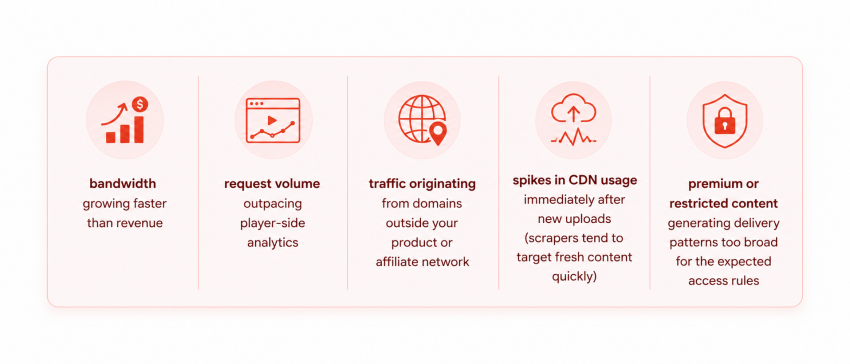
- bandwidth growing faster than revenue
- request volume outpacing player-side analytics
- traffic originating from domains outside your product or affiliate network
- spikes in CDN usage immediately after new uploads (scrapers tend to target fresh content quickly)
- premium or restricted content generating delivery patterns too broad for the expected access rules
A sudden concentration of traffic around a small number of video assets – especially popular or newly released ones – is also worth investigating. CDN logs should be reviewed for unusual referrers, high volumes of empty referrers, and requests from abnormal user agents that suggest automated tools rather than browser-based playback.
How CDN-Level Hotlink Protection Works
Hotlink protection works by adding access validation before the CDN delivers a file. The core idea is to make knowing a URL not enough to be able to receive the content it points to – to make every request prove it belongs to an approved playback flow.
Here are some of the methods used:
- Signed URLs and secure tokens are typically the strongest foundation. A signed URL embeds a cryptographic token that ties the link to specific conditions, such as the file path, an expiry timestamp, or a session identifier. The backend generates a fresh signed URL when a user initiates playback and passes it to the video player. The CDN verifies the token on every request and rejects anything that fails validation. Short TTLs are typically used for video segment URLs, so copied links expire quickly.
- Referrer validation checks whether a request appears to originate from an approved domain. It is a useful first filter for catching straightforward third-party embeds, but it should not be the only control. The Referer header can be absent or unreliable depending on browser privacy settings, extensions, or the referring page’s referrer policy. It works well as an outer layer, but it is not sufficient protection for high-value content on its own.
- Cookie-based session validation extends access control to the session level. Rather than asking only whether a request knows the URL, the CDN also asks whether it carries a valid session signal. For platforms with member areas, paywalled libraries, or tiered access levels, this adds meaningful protection: a copied link from a paid account will not work for an unauthenticated user if the session cookie isn’t also present.
- Geo-restrictions limit delivery to approved regions. They are useful for licensing compliance and for reducing abuse concentrated in specific markets, though they do not verify that any individual request is authorized. They only control geography. Rate limiting helps catch abnormal request patterns from the same IP, token, or session, which can indicate scraping, segment harvesting, or automated mass access.
As you’ve probably guessed, the most effective setups combine several controls – signed URLs for the baseline, cookies for session validation, referrer checks for domain filtering, geo-rules where required, and rate limits for catching automated abuse. Secrets – digital authentication credentials – also need to be managed carefully because they are used to generate URL signatures and encrypted links. In some cases, crawler access should be handled separately, so legitimate search bots can index approved content without opening the same bypass to spoofed traffic.
While no single method closes every exposure, when they’re used together in the right way, the controls can create a layered protection model that makes hotlinking difficult to both execute and sustain.
What Effective Hotlink Protection Should Include
Effective hotlink protection needs the right balance of clear access policies, short-lived media access, controlled exceptions, abuse monitoring, secret rotation, bot detection, and regular rule tuning. Blocking unauthorized use shouldn’t ever come at the cost of damaging legitimate playback, search visibility, and user experience.
For video platforms, protection rules need to match the actual access model: public, subscription-based, regional, partner-distributed, or ad-supported. The stricter the rules, the more carefully they need to account for browsers, players, crawlers, partner domains, and valid user sessions.
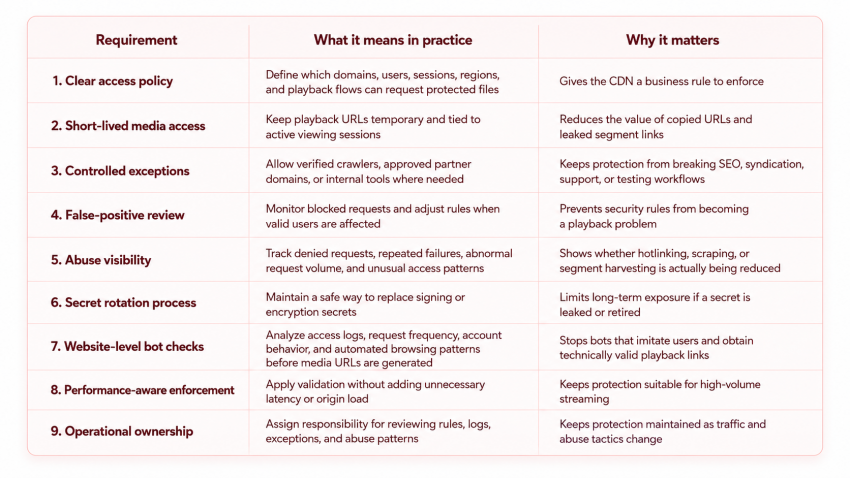
A free ad-supported video site, a subscription platform, an adult content library, and a regional OTT service will not use the same protection policy. One may need stronger domain control to protect ad revenue. Another may need tighter session validation to protect paid content. Another may need regional enforcement for licensing. Another may need verified crawler access so protected content can still be indexed. And the list goes on.
The CDN-level protection should connect with website-level controls. If a bot can enter the site, behave like a normal user, and generate valid playback links, the CDN may see legitimate-looking requests. Access-log review, bot detection, account-level abuse signals, and request-volume checks help catch abuse before valid media URLs are created.
Hotlink protection should be treated as its own entire operating process. Rules need to be reviewed against real traffic, blocked requests, support issues, crawler behavior, and changing abuse patterns.
Secure every playback request with our Video CDN
Where Does DDoS Protection Fit into Video CDN Security?
Hotlink protection and DDoS protection are directly tied because hotlink protection acts as a specific, targeted layer of your overall DDoS defense. Within video CDN security, DDoS protection serves as the availability layer, keeping the global CDN, delivery endpoints, and origin-facing infrastructure online when hostile traffic tries to overload the network. Hotlink protection adds to this defense by controlling access and preventing the unauthorized use of your content.
When combined with bot and scraping controls that eliminate automated abuse, these systems work together to ensure your media delivery infrastructure remains available and secure.
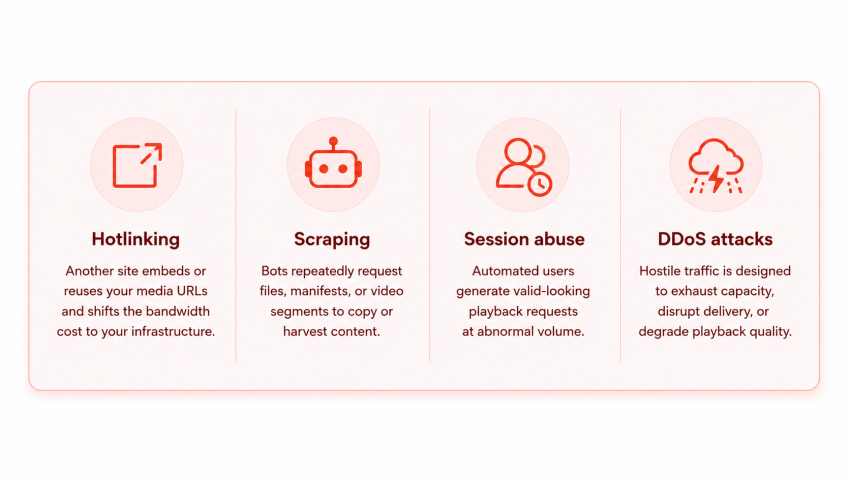
For video platforms, abuse often starts with unauthorized access, but it can also turn into a stability problem. A hotlinking site may send large volumes of real viewer traffic to your media files. Scrapers may request manifests, files, and video segments repeatedly. Automated tools may create request spikes that look different from normal playback behavior. DDoS attacks push this further by targeting service availability itself.
A complete video CDN security setup should account for several traffic risks:
DDoS protection is so crucially needed because video delivery depends on sustained availability. Even a well-protected file is still a problem if viewers cannot reach it during an attack. A distributed CDN design helps by spreading delivery across many nodes instead of concentrating traffic in one narrow point. This makes low- to mid-scale attacks harder to turn into a full-service outage, because the network has more capacity and more paths for absorbing traffic.
DDoS protection and access control solve different dimensions of the same problem. Access controls decide whether a request should receive protected content. DDoS protection helps decide whether traffic should be absorbed, limited, filtered, or escalated before it affects delivery.
For high-risk platforms, DDoS planning should cover CDN capacity, origin exposure, cache behavior, request patterns, traffic spikes, and mitigation escalation.
Conclusion
The safest way to protect video delivery costs is to make every media request accountable. A CDN should know who is allowed to access a file, how long that access should last, where the request can come from, and when traffic behavior starts to look abusive.
For video platforms, this turns protection from a technical add-on into a business control. You reduce wasted bandwidth, protect paid content, limit automated abuse, and keep delivery capacity focused on real viewers.
If your bandwidth bill keeps growing faster than your real audience, Advanced Hosting’s Video CDN can help you close those holinking gaps with access controls, traffic filtering, DDoS protection, and delivery infrastructure built for high-volume streaming.
What is video hotlink protection?
Video hotlink protection is a CDN-level control that stops third-party websites from using your direct video URLs to stream content through their own pages. It checks playback requests before delivery, so having the file link alone is not enough to access the video.
Why is hotlinking expensive for video platforms?
Hotlinking is expensive because every unauthorized playback still uses your CDN bandwidth. With video, the cost grows fast because MP4 files, HLS playlists, DASH manifests, and video segments all generate delivery traffic that you pay for.
How can I tell if my videos are being hotlinked?
The clearest sign is a mismatch between CDN usage and business metrics. If bandwidth, request volume, or segment delivery keeps growing while real sessions, subscriptions, ad revenue, or authenticated views stay flat, hotlinking may be part of the problem.
Is referrer validation enough to stop video hotlinking?
Referrer validation helps block simple third-party embeds, but it should not be the only protection method. Referrer data can be missing, changed by browser settings, or affected by privacy policies. Stronger setups usually combine referrer checks with signed URLs, session validation, rate limits, and abuse monitoring.
How does DDoS protection relate to hotlink protection?
DDoS protection keeps video delivery available during hostile traffic spikes. Hotlink protection controls who can access the content. Together, they help protect both cost and availability: one limits unauthorized media use, while the other helps keep the CDN and delivery endpoints online under attack.