Log in


AI summary
Overview: The article examines how content-delivery network (CDN) billing affects video streaming platforms, contrasting per-gigabyte metered pricing with fixed monthly bandwidth (flat-rate) models and explaining why streaming workloads create distinctive cost pressures.
Streaming traffic is continuous and segment-driven: players repeatedly request short media segments throughout a session, producing sustained outbound throughput and very high request counts. This pattern amplifies three cost drivers—per-request fees, origin egress charges when origins are off-cloud, and wide variation between concurrent viewer counts and actual data delivered depending on average bitrate.
Per-GB pricing charges for every gigabyte delivered, typically with volume tiers, but it exposes operators to unlimited spend as viewership grows and to regional price differentials that raise blended rates. In streaming, request fees and origin egress can materially increase the effective cost beyond headline per-GB figures, undermining predictability during traffic growth or geographic diversification.
Flat-rate bandwidth assigns a fixed monthly fee for a port capacity (e.g., 10 Gbps) so total spend is stable regardless of bytes moved. At sufficient and sustained utilization this model yields lower effective per-GB costs and eliminates origin egress exposure from cache refills, but it requires careful vendor selection to avoid oversold or throttled connections that reduce reliability.
Core message: For platforms with sustained, growing, or globally distributed audiences, flat-rate bandwidth paired with negotiated CDN terms typically becomes more predictable and cost-efficient once monthly delivery and utilization reach an inflection point; the decision depends on average delivery volume, geographic mix, and whether traffic is steady or bursty. A practical indicator is when CDN bills rise faster than viewer count, which often signals metered origin costs that merit reassessment.
Per-GB CDN pricing is the default model for many streaming platforms and one of the fastest-growing infrastructure costs as audiences scale. At 10,000 concurrent viewers, even a moderately compressed 1080p stream can create tens of Gbps of sustained outbound traffic. On Amazon CloudFront, for example, North American data transfer is priced at $0.085 per GB for the first 9 TB after a 1 TB free tier. A platform delivering 500 TB per month to a primarily North American audience can therefore expect a CDN bill in the tens of thousands of dollars before request fees, regional price differences, taxes, support, or any other infrastructure costs are counted. When regional pricing is added to the equation, the bill becomes even harder to forecast.
This article explains why per-GB pricing compounds so aggressively at streaming scale when prices vary across regions, where operators consistently underestimate the bill, and at what volume flat-rate bandwidth becomes the more predictable and cost-effective model.
How is streaming traffic different from general web traffic?
A streaming platform using HLS or MPEG-DASH delivers video as a continuous sequence of short segments, typically two to six seconds each. Each player requests a new segment throughout the entire viewing session without pause. A viewer watching a two-hour live event makes between 1,200 and 3,600 segment requests in that session, depending on segment length. The traffic does not spike and settle. It sustains at high volume for as long as the stream runs.
This creates three cost pressures:
- High request volume: AWS CloudFront charges $0.0075 per 10,000 HTTP requests and $0.0100 per 10,000 HTTPS requests for US, Mexico, and Canada traffic, with HTTPS rates running higher in other regions: up to $0.022 per 10,000 in South America. At 36 million segment requests per hour (the volume a single live event at 10,000 concurrent viewers can generate), request fees alone run into tens of dollars per hour before any data transfer is counted.
- Origin fetch costs depend entirely on where your origin sits: Data transferred from an AWS origin to CloudFront is free of charge. That waiver only applies to AWS-native origins talking to CloudFront. Origins hosted outside AWS, or traffic flowing to a different CDN entirely, are billed at standard regional data transfer rates with no such waiver. For platforms running their own dedicated origin infrastructure (which is common in live streaming), origin egress is a real and recurring charge.
- Concurrency does not predict cost: Streaming platforms measure audiences in concurrent viewers. CDN bills are in gigabytes. Translating between the two requires knowing the average delivered bitrate: the weighted average of what video quality each player actually selects across your audience. A platform with an average delivered bitrate of 2.5 Mbps per viewer and one with an average of 5 Mbps per viewer can report identical concurrency numbers while generating a 2x difference in actual data delivered.
How does the per-GB pricing model work?
The per-GB CDN pricing model charges a fixed rate for every gigabyte of data delivered from the CDN to end users, with volume tiers that reduce the rate as monthly delivery grows. On Amazon CloudFront, North American and European data transfer is free for the first 1 TB per month, then $0.085 per GB for the next 9 TB, $0.080 per GB for the next 40 TB, and $0.060 per GB for the next 100 TB. Those tiers make the pricing look friendlier at volume than it often is in practice once regional rates are factored in.
Two characteristics of the per-GB model create problems specifically for streaming platforms:
- Cost scales with every growth event. There is no ceiling on per-GB spending. Every viral moment, major live broadcast, or successful marketing campaign that drives additional viewership is also a billing event, because the rate per gigabyte does not change based on why the traffic arrived. It changes only based on how much of it there is. This creates a structural mismatch between growth and financial planning.
- Regional rates are not uniform. CloudFront’s published rate for the first tier above the free allowance is $0.085 per GB in the US, Mexico, and Canada, and the same $0.085 in Europe, Israel, and Türkiye. South Africa, Kenya, Nigeria, Egypt, and the wider Middle East region are priced at $0.110 per GB at the same tier—roughly 30% higher. A platform with a meaningful share of its audience outside North America and Europe pays a blended rate well above the headline figure most cost models start from.
What is flat-rate bandwidth pricing?
Flat-rate bandwidth pricing means paying a fixed monthly fee for a port of a specified speed and using as much of that capacity as you need, with no per-GB charges on top. A 10 Gbps flat-rate port costs the same whether you push 10 TB through it or 300 TB. The total cost is fixed. Your monthly infrastructure bill stays predictable regardless of how many viewers show up or how long the stream runs.
The unit cost of bulk bandwidth has fallen significantly over the past several years, which is what makes flat-rate pricing viable at the infrastructure layer. TeleGeography’s IP transit pricing data shows that 100 Gigabit Ethernet port prices in competitive US and European markets fell 25% between Q2 2019 and Q2 2022. As of Q2 2025, the lowest 100 GigE prices on offer in the most competitive hubs like Miami, London, and Singapore held steady at $0.05 per Mbps per month. Providers can offer flat-rate pricing at competitive monthly fees because the underlying transport cost has fallen enough to absorb high-utilization customers.
For streaming platforms, the flat-rate model has a second advantage beyond predictability: it changes the economics of CDN cache misses. When your origin server runs on flat-rate bandwidth, repeated cache fills from your origin generate no additional per-GB charges, regardless of how often the CDN’s cache expires and re-fetches. For live streaming specifically, where short segment lifespans mean frequent re-fetching from origin, this removes a cost variable that scales with the same traffic growth driving up the CDN bill.
Flat-rate bandwidth has one risk worth understanding: providers who advertise unmetered or flat-rate plans but throttle or de-prioritize traffic once it crosses an undefined threshold. This is how some providers manage oversold network capacity. For a streaming platform, a throttled connection during a live event is a viewer-facing outage. When evaluating a flat-rate provider, the key question is not whether they offer the pricing model. It is whether they operate owned backbone infrastructure with genuine capacity headroom, or whether the flat-rate label is sitting on top of shared, oversold infrastructure with hidden limits.
Move to video streaming infrastructure designed for sustained traffic and cost control
Is flat-rate pricing better for streaming platforms?
Flat-rate pricing is better for streaming platforms once monthly delivery volume is high enough that the fixed port cost produces a lower effective per-GB rate than the CDN’s metered pricing. The crossover point is a function of port cost, average port utilization, and the per-GB rate you are currently paying.
For example, a 10 Gbps flat-rate port at 50% average utilization moves roughly 162 TB per month. If that port costs $5,000 per month, the effective per-GB rate is $0.031—below CloudFront’s $0.085 first-tier rate for North American delivery and well below the blended rate for a platform with audiences in higher-cost regions. At that point, every additional terabyte you move lowers the effective per-GB rate of the flat-rate model further, while the per-GB model charges close to the same rate regardless.
Operators who run their origin infrastructure on flat-rate bandwidth and pair it with a negotiated enterprise CDN contract for edge delivery achieve the largest cost reduction. The flat-rate origin removes per-GB exposure on origin traffic entirely. The CDN handles edge delivery at a contracted rate well below the public per-GB rate card. The two tiers together change the economics of the entire delivery stack, not just one line on the invoice.
The cost comparison between per-GB and flat-rate pricing at scale
The table below models CloudFront’s published US/Canada/Mexico tiers against a flat-rate origin paired with a negotiated enterprise CDN rate. The per-GB column reflects CDN edge delivery and request fees only, using AWS’s current published tiers in full. The flat-rate column assumes a dedicated origin on a flat-rate port plus an enterprise CDN contract negotiated at AWS’s custom-pricing tier for committed monthly volume.
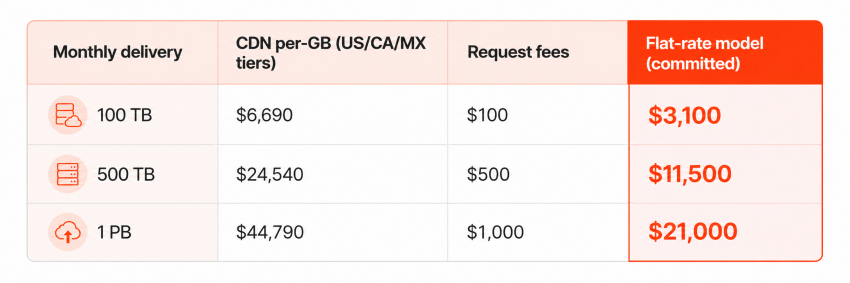
Per-GB figures are calculated by applying CloudFront’s published US/Canada/Mexico tier rates in sequence to each volume. Flat-rate figures are illustrative, based on a $5,000–$10,000 monthly port cost at 50% utilisation combined with AWS’s custom committed-volume pricing.
The flat-rate model is 47 to 48% cheaper across all three delivery volumes.
How to build a CDN cost model that accounts for all of this
An accurate CDN cost model for a streaming platform needs to account for four separate cost layers, not just the headline per-GB CDN rate.
- Edge delivery cost: CDN egress from edge to end users, at the blended per-GB rate across all regions where your audience is located. Weight this by geographic distribution, not by a single representative rate.
- Request-based fees: HTTPS request counts multiplied by your CDN provider’s per-10k-requests rate. For live streaming with short segments, this can represent 5 to 10% of the total CDN cost. For LL-HLS, model it higher.
- Storage costs: all renditions of all assets stored in your origin and CDN cache, billed at object storage rates. For large VOD libraries with multiple ABR renditions, this can be a significant fixed cost independent of delivery volume.
Once you have all three layers modelled at your current volume, project them at 2x and 5x current volume. That projection reveals where the inflection point is: the volume at which the per-GB cost model stops being viable and flat-rate infrastructure becomes significantly cheaper. Most streaming platforms hit that inflection point earlier than their finance teams expect, because the model is typically built on the per-GB headline rate without the origin egress and request fee layers.
When is per-GB pricing still the right choice?
Per-GB pricing is still the right choice for streaming platforms at lower delivery volumes. CloudFront’s always-free tier covers 1 TB of data transfer and 10 million HTTP/HTTPS requests every month indefinitely, and for platforms below roughly 10 TB of monthly delivery, the total CDN bill stays in the low hundreds of dollars. This is well below the fixed cost of a flat-rate port with meaningful capacity.
Per-GB also works for platforms with genuinely variable traffic. A sports broadcaster running 10 events per year with near-zero delivery volume between them should not pay for infrastructure sized for peak concurrent load. The fixed cost of a flat-rate port is a monthly charge regardless of utilization. A variable per-GB model absorbs that pattern without requiring capacity planning or locking capital into idle infrastructure.
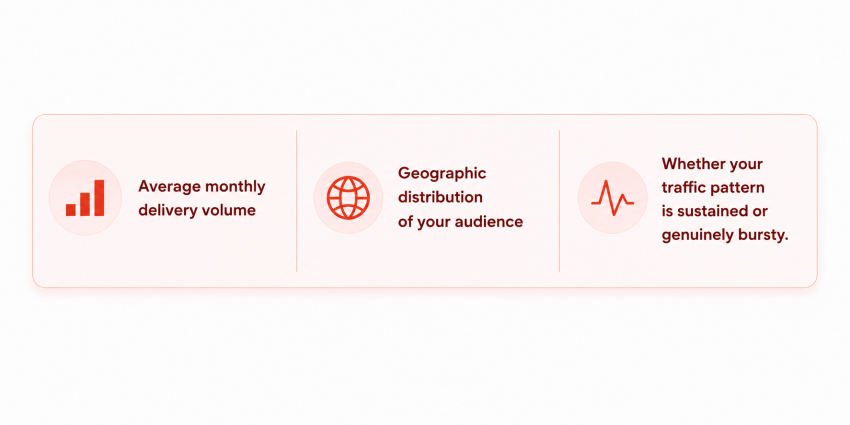
The decision between per-GB and flat-rate ultimately comes down to three variables:
Platforms with growing, international, and sustained audiences reach the flat-rate crossover faster than they expect, and the reason is usually that the cost comparison was run on CDN edge delivery alone, without factoring in origin infrastructure costs for non-AWS-native origins or the request fee layer that streaming’s segment-based delivery generates.
A useful rule of thumb: if your CDN bill is growing faster than your viewer count, it is worth checking whether your origin infrastructure is on a metered or flat-rate model, since that is usually where unaccounted-for cost is hiding.
If your CDN bill is growing faster than your viewer count, the origin is usually where the answer is. Advanced Hosting’s team can model the cost comparison against your current setup.
Why do CDN egress fees grow faster than viewer count?
CDN egress fees grow faster than viewer count when the average delivered bitrate rises alongside audience size, when an increasing share of viewers falls into higher-cost geographic regions, and when per-GB rates do not drop fast enough through volume tiers to offset the growing volume. Streaming platforms with international growth are particularly exposed: adding viewers in Asia-Pacific or the Middle East costs more per gigabyte delivered than adding the same number of viewers in North America, so the per-viewer cost rises even if total viewer count grows linearly.
At what monthly delivery volume does flat-rate bandwidth become cheaper than per-GB CDN pricing?
The crossover depends on port cost, average utilization, and the per-GB rate in your current CDN contract. As a working example: a 10 Gbps flat-rate port at 50% average utilization moves roughly 162 TB per month. If that port costs $5,000 per month, the effective per-GB rate is $0.031, well below CloudFront’s published $0.085 first-tier rate for North American delivery. At that point, flat-rate is already cheaper. The crossover almost always arrives earlier than operators expect, because most cost comparisons are run on CDN edge delivery alone without accounting for origin infrastructure costs and request fees.
Does AWS charge for data transfer from S3 or EC2 to CloudFront?
No. Data transferred from AWS-native origins such as S3 buckets, EC2 instances, or Application Load Balancers to Amazon CloudFront is free of charge. That waiver applies only within the AWS ecosystem. If your origin runs on a different provider’s infrastructure, or if you are sending traffic to a CDN other than CloudFront, standard data transfer rates apply with no waiver.
What is the Bandwidth Alliance and how does it affect egress costs?
The Bandwidth Alliance is a partnership programme led by Cloudflare, under which member providers agree to waive or significantly reduce egress fees for traffic flowing between alliance members. Qualifying storage and cloud providers in the alliance can send traffic to Cloudflare’s network without paying standard egress rates. The alliance currently includes over 20 providers. It reduces egress costs specifically for traffic between alliance members. However, it does not affect traffic between non-member providers, and it does not cover all CDN providers or cloud platforms.
Why are CDN costs higher for audiences in Asia-Pacific and the Middle East?
CDN pricing varies by region because the underlying cost of delivering traffic differs by geography. Infrastructure density, peering availability, last-mile network quality, and local bandwidth market conditions all affect what a CDN pays to deliver traffic in a given region. Those costs are passed through to customers in the form of regional pricing tiers. North America and Europe have the densest CDN infrastructure and the most competitive bandwidth markets, which is why per-GB rates there are lowest. Less connected regions carry higher delivery costs, and CDN providers price accordingly.
What CDN pricing model works best for live streaming specifically?
For live streaming at scale, a hybrid model tends to work best: a flat-rate or committed-volume arrangement for origin infrastructure combined with a negotiated enterprise CDN contract for edge delivery.