Log in


AI summary
Overview: The article analyzes buffering in large-scale video streaming services, identifying how architectural limits in delivery and storage infrastructure undermine playback continuity and viewer engagement.
It attributes buffering primarily to three system-level failures: origin servers overwhelmed by concurrent requests, inefficient content caching at the CDN edge that forces recurring origin fetches, and latency or packet loss introduced by long-distance routing between users and centralized data centers.
The recommended mitigations emphasize a distributed, media-optimized delivery stack: persistent edge caching, adaptive CDN routing, local points of presence, NVMe-equipped delivery nodes for high IOPS, and a tiered distributed storage backend that separates hot, warm, and cold media.
Core message: To prevent buffering at scale and protect engagement and revenue, platforms must adopt high-throughput, geographically distributed delivery and storage architectures that maximize cache hit rates, minimize origin dependence, and align performance with regional compliance requirements.
Video buffering can quickly damage viewer engagement, especially on high-traffic streaming platforms handling large volumes of concurrent users. This article explains the main technical causes of buffering, including overloaded origin servers, inefficient CDN caching, and long-distance routing issues. It also explores how modern streaming infrastructure uses edge caching, NVMe-powered delivery nodes, distributed storage systems, and intelligent CDN routing to maintain stable playback and improve user retention at scale.
Eliminating Buffering in High-Traffic Video Streaming Platforms
In the modern streaming landscape, a spinning loading wheel is the ultimate conversion killer. When thousands of users hit “Play” simultaneously, the underlying infrastructure for high-load platforms faces a brutal test. If that infrastructure buckles, viewers don’t wait around, they bounce.
Building a flawless, buffer-free streaming experience requires moving past legacy setups and embracing a modern, scalable media infrastructure. Let’s dive into the technical bottlenecks that cause buffering and how next-generation architecture eliminates them.
The Technical Causes of Buffering
To fix buffering, we must first understand why it happens. At its core, buffering occurs when a playback device runs out of video data in its local buffer. This is usually triggered by three main architectural failures:
1. Overloaded Origin Servers
When millions of viewers attempt to watch a live event or a trending release, traditional origin servers face massive concurrent requests. Without a robust infrastructure for traffic-intensive services, these servers experience CPU and I/O exhaustion, leading to slow response times and dropped connections.
2. Poor CDN Cache Distribution
If your Content Delivery Network (CDN) fails to cache video segments efficiently, it results in frequent “cache misses.” When this happens, the CDN must constantly fetch data back from the primary media asset storage. This unnecessary back-and-forth clogs the pipeline and stalls playback.
3. Long-Distance Routing
When data has to travel across oceans or continents from a centralized data center to an end-user, it encounters long-distance routing issues. This physical distance inherently increases latency and the probability of packet loss, making seamless streaming impossible.
How Modern CDNs Prevent Buffering?
To combat these challenges, engineering teams must leverage high-performance content delivery networks designed specifically for rich media.
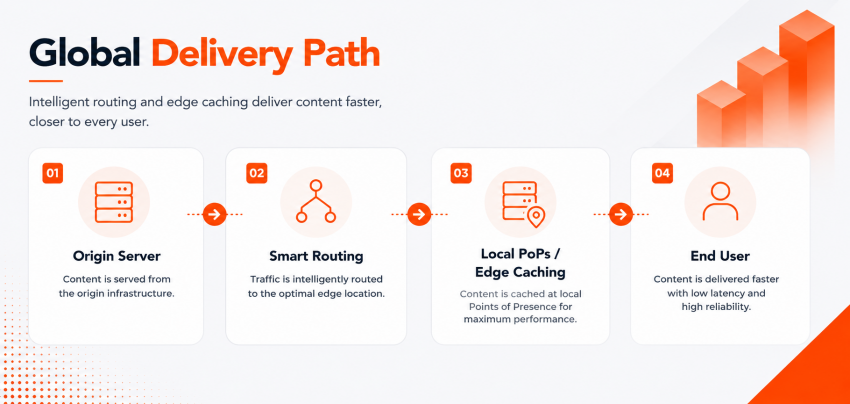
- Edge Caching: By storing video segments at the network’s edge, content is delivered from mere miles away from the user rather than thousands of miles away.
- Smart Routing: Modern networks dynamically optimize paths based on real-time internet congestion, bypassing bottlenecked routes entirely.
- Local PoPs (Points of Presence): Establishing localized infrastructure drastically reduces round-trip time (RTT) and improves initial video startup times.
This localized approach relies on a deeply distributed media architecture to ensure no single data center becomes a point of failure.
Why NVMe Edge Nodes Matter for High-IOPS Video Delivery?
Standard hard drives and older SSDs simply cannot handle the high-IOPS (Input/Output Operations Per Second) demands of concurrent 4K or 8K video streaming. This is where edge-accelerated media delivery powered by Non-Volatile Memory Express (NVMe) architecture becomes non-negotiable.
The NVMe Advantage: NVMe drives communicate directly with the system CPU, bypassing legacy storage protocols.
For high-traffic streaming platforms, deploying NVMe at edge nodes delivers three critical benefits:
- Blazing-Fast Read/Write Performance: Large media files and adaptive bitrate (ABR) video chunks are fetched and served instantly.
- Massive Concurrency Handling: Thousands of unique users can request the exact same video segment simultaneously without drive throttling.
- Ultra-Low Latency: Eliminating drive-level bottlenecks ensures that video data reaches the network pipeline with zero friction.
Cache Hit Rate vs. Playback Stability
Your Cache Hit Ratio (CHR) is the ultimate health metric for video delivery performance. It measures the percentage of content requests served directly by the CDN edge versus those that had to be pulled from the origin.
| Cache Hit Ratio | Origin Burden | Playback Experience | Buffering Risk |
| Low (< 70%) | High (Frequent fetches) | High latency, stuttering | Critical |
| High (> 95%) | Minimal (Protected) | Ultra-low latency, smooth | Negligible |
A higher cache hit ratio means fewer origin requests, leading directly to lower latency and smoother playback. By maximizing this metric, platforms drastically reduce the risk of buffering during sudden spikes in peak traffic.
Scaling the Storage Layer
An efficient edge network is only as good as the backend storing the master files. High-traffic platforms require a tiered, distributed storage systems approach:
- Hot Storage: Active, trending content lives on high-velocity object storage for video, optimized for immediate access.
- Warm Storage: Standard catalog titles are kept in scalable large-scale storage clusters that balance cost and retrieval speed.
- Cold Storage: Historical content and raw footage are pushed to cost-effective archival media storage.
By tying these tiers into scalable storage backends and utilizing high-throughput, high-capacity content storage, platforms can scale their libraries infinitely without degrading delivery performance.
Real-World Impact: Retention and Revenue
Technical metrics matter because they directly dictate business outcomes. In the streaming industry, performance is product quality.
- Buffering Increases Abandonment: Studies show that viewers begin abandoning a video if it takes more than two seconds to start, with every additional second of buffering driving up abandonment rates exponentially.
- Faster Playback Drives Engagement: When videos load instantly, viewers stay immersed, leading to significantly longer session times.
- Direct Impact on Monetization: Whether your platform relies on SVOD (subscriptions) or AVOD (advertising), longer sessions translate directly into higher ad impressions and reduced subscriber churn.
Building a Global, Compliant Streaming Future
As platforms scale internationally, technical architecture must also intersect with local regulations. Managing data across borders requires sophisticated, region-specific compliance measures to ensure user privacy and compliance with data sovereignty laws (such as GDPR or CCPA) are respected without sacrificing delivery speeds.
Ultimately, achieving a buffer-free global footprint requires a performance-driven infrastructure designed for the future of media.
Ready to Scale Your Streaming Infrastructure?
Don’t let legacy hardware bottleneck your platform’s growth. To deliver flawless, low-latency video to global audiences at any scale, you need a hosting partner built for the job.
Discover how Advanced Hosting provides the enterprise-grade media hosting and bandwidth-optimized delivery systems your platform needs to eliminate buffering forever.
Contact Advanced Hosting Today to Supercharge Your Streaming Performance
Why do streaming platforms use multiple storage tiers for video content?
Large video platforms rarely keep all content on the same storage layer. Frequently accessed media is stored on high-speed infrastructure, while older or rarely viewed files are moved into lower-cost tiers. This approach improves operational efficiency while maintaining fast delivery for active content libraries.
How does object storage improve scalability for streaming services?
Modern streaming platforms often rely on object-based architectures because they simplify horizontal expansion across multiple regions. Unlike traditional file systems, object storage scales efficiently when handling billions of media files, metadata records, and concurrent delivery requests.
Why is edge infrastructure important for global video delivery?
Edge infrastructure reduces the physical distance between users and streaming content. By placing cached media closer to end users, platforms can improve startup times, stabilize adaptive bitrate playback, and reduce the impact of regional network congestion.
How do distributed storage environments improve platform reliability?
Distributed environments replicate content across multiple nodes and geographic locations. If a server or data center experiences issues, traffic can be redirected automatically to healthy infrastructure without interrupting playback availability.
What role does media storage architecture play during traffic spikes?
When viral events or live broadcasts generate sudden demand, storage systems must process massive numbers of simultaneous read requests. Poorly designed backend storage can become a bottleneck even when the CDN infrastructure is functioning correctly.
Why do streaming platforms separate hot and cold video content?
Keeping all content on premium storage infrastructure is expensive and inefficient. Streaming providers usually separate actively viewed content from older assets to optimize costs while still maintaining long-term retention capabilities for archived media libraries.
How can infrastructure design affect adaptive bitrate streaming performance?
Adaptive bitrate streaming depends on the rapid delivery of small video segments at multiple quality levels. Storage latency, cache efficiency, and routing performance all influence how quickly players can switch resolutions without causing playback interruptions.
Why is regional infrastructure distribution important for international audiences?
Global streaming platforms serve users across different continents, carriers, and network conditions. Regional infrastructure placement helps minimize latency, improve playback consistency, and maintain stable performance during localized traffic surges.
How do modern streaming platforms prepare for unpredictable traffic growth?
Scalable streaming environments are designed with modular infrastructure components that can expand dynamically. CDN capacity, storage nodes, and edge delivery layers are typically distributed across multiple regions to absorb sudden increases in demand.
Why are monitoring and analytics critical for streaming stability?
Real-time analytics allow engineering teams to identify network congestion, overloaded cache nodes, or regional delivery problems before buffering becomes widespread. Continuous infrastructure monitoring is essential for maintaining consistent playback quality at scale.