Log in


AI summary
Overview: The article addresses how video platforms that handle high volumes of user uploads must evolve their moderation approach into a scalable, infrastructure-driven system to manage copyright enforcement, takedown requests, and compliance across distributed CDN and object storage environments.
It explains that manual review is insufficient at scale, causing slow takedowns, fragmented operations, and persistent copies in caches or replicas, which increases legal exposure and operational costs.
Core message: Embedding automated enforcement into storage and delivery layers—using takedown automation, perceptual fingerprinting, immediate edge URL invalidation, and coordinated object deletion—transforms compliance into an infrastructural capability that speeds removals, prevents re-uploads, and reduces liability.
To be effective, platforms need infrastructure vendors that provide low-latency APIs, robust audit logging, and storage optimized for fast, idempotent deletions; failing to integrate these capabilities risks service limitations, higher operational friction, and regulatory or commercial penalties.
Video platforms handling large-scale user uploads face growing pressure from copyright enforcement, takedown requests, and compliance monitoring. This article explores how scalable moderation infrastructure helps media services automate copyright workflows, integrate enforcement directly with storage systems, prevent re-uploaded content, and reduce legal exposure across distributed CDN and object storage environments.
Infrastructure Strategies for Video Platforms Handling Large-Scale Content Moderation
User-generated content (UGC) ecosystems scale faster than manual moderation ever could.
Modern YouTube-style platforms process millions of uploads daily, turning copyright enforcement from a legal box-checking exercise into a continuous infrastructure challenge. Even mid-sized platforms handling user uploads, clips, livestreams, or archived media encounter a non-stop barrage of takedown requests from rights holders, automated monitoring services, and anti-piracy agencies.
For digital media platforms, copyright complaints are a predictable vector of high-volume infrastructure operations. As a platform’s audience grows, it naturally attracts a dense ecosystem of external monitoring:
- Automated Copyright Crawlers: Proprietary bots deploying automated scraping techniques to detect protected assets.
- Third-Party Anti-Piracy Vendors: Specialized firms hired by studios to police digital media libraries.
- Continuous Duplicate-Content Scanning: Network-level monitors track content redistribution in real time.
Any environment supporting high-volume media traffic inherently spikes the probability of copyrighted material leaking into the media library. This challenge intensifies exponentially on services distributing short-form edits, fan compilations, reaction videos, and redistributed broadcast content. When upload frequency rises, compliance workflows must be treated as distributed systems problems rather than moderation-only problems.
Why Manual Moderation Fails at Scale?
Human review cannot keep pace with continuous, high-velocity upload streams. While growing video services initially rely on support teams to manually review complaints, locate files, and purge content, this approach collapses under the weight of rapid upload growth, geographically distributed users, and burst-heavy traffic spikes during peak engagement periods.
Manual workflows introduce severe operational risks across the engineering stack:
Delayed Takedown Response & Legal Exposure
Rights holders expect immediate remediation upon submitting notices. Slow response times increase a platform’s legal exposure, escalating the risk of DMCA-related safe-harbor forfeiture, payment processor restrictions, and upstream provider warnings. When traffic-intensive workloads generate thousands of complaints an hour, manual queues inevitably back up.
Operational Bottlenecks & Margin Erosion
Without automation, moderation overhead scales linearly with platform growth, eroding revenue margins. Support queues expand indefinitely, compliance tracking becomes fragmented, and engineering teams get pulled away from core product development to handle operational cleanup and repetitive re-uploads.
Distributed Infrastructure Enforcement Gaps
Modern video delivery stacks are highly distributed, typically comprising:
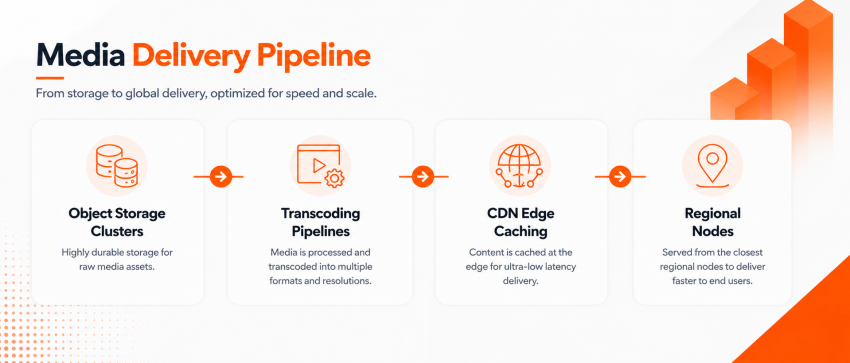
If moderation systems are decoupled from the core storage infrastructure, removing a file from a database does not guarantee global removal. Content often remains active and accessible via cached CDN edge URLs or replicated regional storage layers, resulting in critical compliance failures.
Technical Tools to Simplify Copyright Enforcement
Automation transforms moderation from a reactive support workflow into an infrastructure-level policy engine operating directly inside storage and delivery systems.
| Technical Tool | Operational Function | Infrastructure Impact |
| Takedown Automation | Ingests API notices, validates metadata, and triggers automated removal. | Eliminates human intervention; reduces response times from hours to milliseconds. |
| Content Fingerprinting | Generates perceptual hashes of video/audio to block matching uploads. | Prevents repetitive moderation cycles and reduces duplicate storage costs. |
| URL-Level Edge Blocking | Purges or invalidates URLs across the CDN cache instantly. | Provides immediate public mitigation while backend storage deletion propagates. |
| Storage-Level Deletion | Orchestrates hard deletion across object stores and regional replicas. | Ensures complete compliance with data sanitization without accidental restorations. |
1. Takedown Automation
Modern compliance pipelines leverage webhook-driven APIs to receive incoming notices, cross-reference metadata, identify the target assets, and trigger purge sequences automatically. This ensures legal consistency and removes human error from the critical path.
2. Content Fingerprinting
To prevent previously removed media from returning under different filenames or resolutions, platforms must implement acoustic and visual fingerprinting. By scanning incoming uploads against a database of known infringing hashes, platforms can block mirrored content at the ingestion level, heavily reducing redundant storage costs for high-bitrate video.
3. URL-Level Blocking vs. Storage-Level Deletion
True compliance requires a two-pronged approach to data removal.
First, URL-level blocking invalidates CDN edge delivery and denies playback access within seconds, critical for latency-sensitive traffic. Second, a centralized orchestration layer must execute storage-level deletion, ensuring that underlying object storage files are wiped, database references are scrubbed, and lifecycle automation rules prevent the media from being restored by automated backup routines.
How Infrastructure Providers Can Assist?
Compliance-sensitive platforms require infrastructure partners whose systems are built for automated high-volume operations.
API Integration for Automated Workflows
Leading infrastructure providers expose robust, low-latency APIs for storage manipulation and instant CDN invalidation. These event-driven hooks allow a platform’s moderation engine to execute programmatic deletions the moment a valid complaint is verified, preventing operational backlogs during peak traffic demand.
Comprehensive Compliance Logging
Auditability is just as critical as removal speed. Platforms require deep logging infrastructure that records an immutable audit trail: when a notice arrived, who or what initiated the action, the exact assets targeted, and verification that the purge propagated successfully across all regional nodes. This protects platforms during subsequent rights-holder or vendor disputes.
Scalable Storage with Fast Object Deletion
High-throughput video platforms need storage architectures optimized for idempotent, rapid object deletion and real-time metadata re-indexing. If a storage architecture throttles under heavy delete operations, compliance lags.
Partnering with an infrastructure provider experienced in abuse response procedures, high-risk content operations, and massive data pipelines radically lowers operational friction.
Integrated Compliance Architecture
When moderation is disconnected from infrastructure, critical enforcement gaps emerge. Siloed compliance teams might flag content as “deleted,” but without architectural integration, the asset lives on.
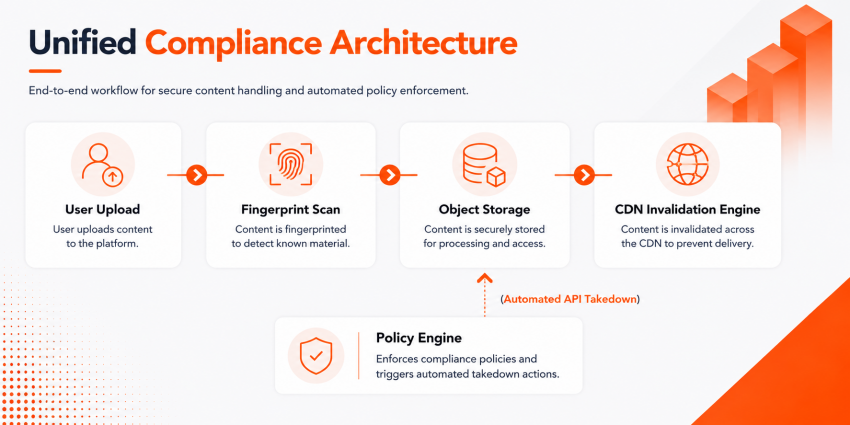
Integrating compliance workflows directly into storage layers, CDN infrastructure, and upload pipelines yields distinct operational advantages:
- Minimized Safe-Harbor Risks: Automated, infrastructure-wide deletion slashes the window of legal liability between complaint ingestion and asset removal.
- Proactive Ingestion Filtering: Content fingerprinting arrests repetitive moderation cycles, killing malicious re-uploads at the perimeter before they consume bandwidth or transcoding compute.
- Decentralized Synchronicity: Orchestrated compliance actions ensure that a single moderation decision propagates instantly across transcoding pipelines, backup systems, and every edge cache node globally.
The Consequences of Neglect
Platforms that treat compliance as an afterthought face swift operational degradation. Upstream infrastructure vendors routinely audit abuse responsiveness; failure to maintain rapid takedown standards frequently results in bandwidth throttling, CDN limitations, or outright service termination. Furthermore, payment processors and strategic partners categorize slow-responding platforms as high-risk, leading to increased transaction fees or dropped relationships.
Building Sustainable Moderation Infrastructure
At scale, copyright enforcement is no longer a legal or customer support challengeit is a core infrastructure design requirement.
As video delivery networks scale, treating compliance as an architectural pillar ensures faster response times, reduced operational overhead, predictable infrastructure costs, and insulated legal exposure. For modern video ecosystems handling continuous user uploads and global traffic distribution, a tightly integrated moderation architecture is the foundation of operational stability.
Optimize Your Compliance Infrastructure
Need an infrastructure stack architected for high-volume, compliance-sensitive media operations?
Advanced Hosting provides highly scalable object storage, automated API-driven workflows, ultra-fast CDN invalidation architectures, and compliance-aware engineering support engineered specifically for platforms handling large-scale media delivery and automated moderation.
How do video platforms handle copyright complaints at scale?
Large video services typically combine automated moderation pipelines, storage-level deletion systems, CDN invalidation, and content fingerprinting tools to process copyright complaints efficiently. This approach is essential for platforms managing continuous uploads and large media libraries.
Why is automation important for content moderation infrastructure?
Automation reduces response delays, minimizes manual workload, and improves compliance consistency. Platforms operating under traffic-intensive workloads often receive complaint volumes that cannot realistically be processed through manual moderation alone.
What role does content fingerprinting play in copyright enforcement?
Fingerprinting systems help identify duplicate or previously removed media by comparing uploaded files against known content signatures. This prevents repeated re-uploads and reduces moderation overhead for services handling streaming media workloads.
Why must moderation workflows integrate directly with storage systems?
Integrated workflows ensure that moderation actions propagate consistently across object storage, CDN caches, replicas, and transcoding pipelines. Without infrastructure-level integration, deleted media may remain publicly accessible in distributed environments.
How do CDN and edge systems affect compliance operations?
CDNs accelerate delivery for latency-sensitive traffic, but cached copies can complicate takedown enforcement. Effective moderation infrastructure must support rapid cache invalidation and synchronized removal across edge locations.
What risks do platforms face if they ignore copyright compliance requirements?
Ignoring compliance obligations can lead to legal disputes, financial penalties, provider restrictions, and reputational damage. Platforms generating significant bandwidth-intensive traffic are often subject to increased scrutiny from upstream vendors and rights holders.
Why do large-scale media services attract more copyright monitoring?
As platforms grow, they become more visible to rights holders and automated anti-piracy systems. Services supporting global traffic distribution and large user communities are more likely to encounter continuous monitoring and higher complaint volumes.
How can infrastructure providers help with content moderation workflows?
Infrastructure providers can support moderation operations through:
- API-based deletion workflows,
- scalable object storage,
- monitoring and compliance logging,
- CDN invalidation systems,
- and support teams experienced with compliance-sensitive environments.
These capabilities are particularly important for on-demand video platforms operating globally.
Why is scalable storage important for moderation-heavy environments?
Platforms storing high-bitrate video content and large media archives require storage systems capable of rapid deletion, metadata indexing, replication control, and automated lifecycle management to maintain compliance efficiency.
What infrastructure challenges are common during traffic spikes?
Services experiencing peak-driven traffic or burst-heavy traffic patterns may encounter upload surges that overwhelm moderation teams and backend systems. Automated moderation pipelines help maintain response speed during periods of elevated activity.