
In this article, we analyze a real client request and explore how to match or improve a GPU-powered video processing setup without increasing costs. We compare configurations, discuss infrastructure differences, and explain what truly matters for stable transcoding and streaming workloads.
Dedicated Servers for Video Processing & GPU Workloads in Amsterdam
When clients approach us with GPU-based video workloads, that usually means that their infrastructure has already grown, traffic is increasing, and operational risks are becoming harder to manage within a single location.
At this stage, the key question is no longer about hardware specs.
It becomes a strategic decision:
How to restructure infrastructure to ensure scalability, redundancy, and compliance with legal and regional requirements.
To illustrate this, let’s look at a real-world scenario.
When Growth Forces Geographic Expansion
The client operated a growing GPU-based processing and streaming platform. Over time, their infrastructure expanded beyond a single-location setup.
Several challenges emerged simultaneously:
- Increasing traffic load across European audiences
- Rising dependency on a single geographic location
- Lack of redundancy at the data center level
- Legal and jurisdictional requirements for data placement
- Higher operational risk in case of regional outages
At this point, scaling within the same location was no longer sufficient.
The decision was made to move part of the infrastructure to Amsterdam, one of Europe’s key connectivity hubs.
It was a partial infrastructure redistribution, designed to improve resilience, compliance, and network performance.

Dedicated Cage Deployment in Amsterdam
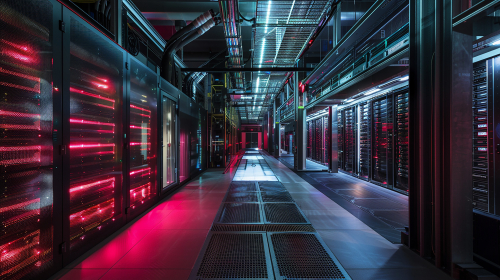
To support this expansion, we deployed a dedicated cage environment inside an Amsterdam data center.
This included:
- Redundant power feeds (A+B)
- Private internal network between nodes
- Top-of-rack switching
- Dedicated uplinks to multiple upstream providers
- Structured rack layout for density and cooling
It is a controlled, isolated infrastructure environment built for predictable operation.
What Changes at the Cage Level?
1. Distributed Computing Instead of Single Points of Failure
Workloads are no longer tied to individual machines:
- GPU processing is distributed across multiple nodes
- Failures do not interrupt the entire pipeline
- Capacity scales horizontally as demand grows
Each server is built using enterprise-grade components:
- Xeon-class CPUs
- ECC memory
- Optimized PCIe layouts for GPU workloads
- Rack-level cooling for sustained performance
2. Storage Designed for Throughput
Instead of relying on mixed or improvised storage setups, the architecture is split into functional tiers:
- NVMe layer for active processing and transcoding
- HDD layer for storage and archives
- Optional replication for data protection
This removes I/O bottlenecks and ensures consistent performance under parallel workloads.
3. Network Built Around Capacity, Not Ports
At scale, network design shifts to total throughput planning:
- Internal traffic flows through private switching
- No dependency on external routing for internal workloads
- Uplinks are sized based on aggregate demand
Amsterdam plays a critical role here due to:
- Strong interconnection ecosystem
- High-quality upstream providers
- Low-latency routes across Europe
4. Redundancy at Every Layer
Unlike single-location deployments, cage infrastructure introduces real fault tolerance:
- Dual power feeds (A+B)
- Redundant PSUs in servers
- Controlled power distribution
- On-site spare hardware availability
This significantly reduces the probability of service disruption.

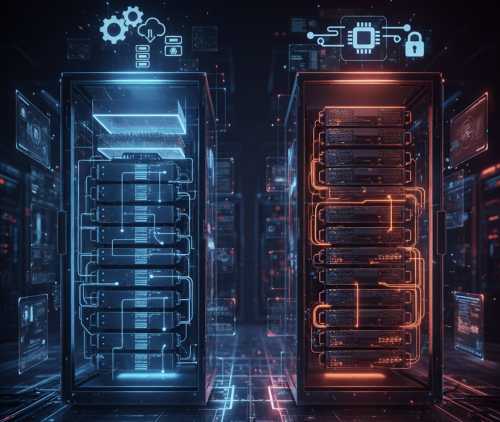
Infrastructure vs SDN: Clear Separation
At this stage, it is important to distinguish between two layers:
Infrastructure:
- Physical servers and GPU nodes
- Racks and cages
- Power, cooling, and hardware
- Network capacity and uplinks
- Storage systems
SDN (Software-Defined Networking):
- Traffic routing logic
- Load balancing
- Failover mechanisms
- Policy-based traffic control
Infrastructure provides stability, performance, and capacity.
SDN provides flexibility and traffic management.
They work together but solve different problems.

Why Amsterdam?
The choice of Amsterdam was driven by two key factors:
Legal and Jurisdictional Considerations
Certain workloads require data to be processed or stored within specific regions. Relocating part of the infrastructure ensures compliance without restructuring the entire system.
Redundancy and Risk Distribution
By splitting infrastructure across locations, the client reduces:
- Dependency on a single data center
- Exposure to regional outages
- Network routing limitations
This creates a more resilient architecture overall.
Cost Efficiency at Scale
While a dedicated cage may seem like a large investment, at scale it becomes economically efficient:
- Lower cost per unit
- Predictable bandwidth pricing
- No hidden overage charges
- Higher hardware utilization
- Reduced need for repeated migrations
Instead of fragmented resources, the client operates a unified infrastructure system.

Scaling Without Rebuilding
The key advantage of this approach is long-term stability.
The Amsterdam deployment is the foundation for growth.
The same environment can expand with:
- Additional nodes
- Increased uplink capacity
- Extended storage clusters
- Integration with CDN and delivery layers
Growth becomes incremental, not disruptive.
At a certain stage, infrastructure growth is no longer about adding servers.
It becomes about architecture, geography, and control.
The real question is not:
“How do we upgrade hardware?”
The real question is:
“How do we build an infrastructure that can scale, comply, and remain stable under continuous load?”
How long does it take to deploy a dedicated cage in Amsterdam?
Deployment timelines depend on the scope and hardware requirements.
For pre-defined configurations with available hardware, initial setup (rack space, power allocation, and base networking) can be completed fairly quickly. Full deployment, including GPU servers, switching, and validation, typically takes longer.
Because we operate within established data center environments and maintain hardware stock, timelines are predictable and confirmed in advance.
Can you help migrate from an existing single-server setup?
Yes. Migration to a multi-node infrastructure is handled as a structured process.
We typically use:
- Parallel deployment (new infrastructure runs alongside the existing one)
- Incremental data synchronization
- Controlled cutover to minimize downtime
For large datasets, we select the fastest and safest transfer method based on volume and operational constraints.
How is storage organized in this type of infrastructure?
Storage is designed based on workload requirements.
A typical approach includes:
- NVMe storage for active processing and transcoding
- HDD storage for archival data
- Optional redundancy or replication layers
This structure improves performance and reduces risks associated with RAID 0 configurations.
How does network capacity scale within a cage?
Cage infrastructure uses internal switching and aggregated uplinks.
This enables:
- high-speed internal communication between servers
- flexible traffic distribution
- scalable external bandwidth capacity
Network design is handled at the infrastructure level, not per individual server.
What’s the difference between SDN and infrastructure?
It is important to distinguish between layers.
Infrastructure provides:
- physical hardware and connectivity
- bandwidth capacity
- reliability and redundancy
SDN provides:
- traffic routing logic
- failover control
- request distribution strategies
They are designed and implemented as separate layers depending on project requirements.
Can this infrastructure be integrated with a CDN later?
Yes. The infrastructure can be extended with CDN integration without redesign.
In this model:
- GPU infrastructure handles processing (transcoding, packaging)
- CDN handles content delivery
This separation improves scalability and reduces load on compute resources
Why choose Amsterdam for this deployment?
Amsterdam is one of Europe’s strongest connectivity hubs.
It offers:
- dense peering ecosystem
- strong connectivity across Europe, the UK, and the US
- consistent low-latency routing
For video workloads targeting European audiences, this results in more stable and predictable performance.
Is dedicated infrastructure cost-effective?
At scale, dedicated infrastructure often becomes more cost-efficient due to:
- predictable bandwidth pricing
- better hardware utilization
- elimination of repeated migrations
- centralized resource management
This leads to improved long-term cost control.
Can the infrastructure be customized?
Yes. All components can be tailored to your requirements:
- GPU models (based on availability)
- CPU and memory configuration
- storage architecture
- network capacity
- redundancy levels
We do not rely on fixed packages infrastructure is built around the workload.