
AI summary
The article discusses the evolving landscape of server purchasing, highlighting how the demand for artificial intelligence (AI) is significantly impacting the server and storage components market, projected to reach $244 billion in 2024. This shift has introduced volatility in pricing and availability across various components, including CPUs, GPUs, memory, storage, networking, and power/cooling systems.
As AI demand escalates, traditional supply chains are disrupted, leading to increased costs and longer lead times for essential components. The article emphasizes that organizations must navigate these challenges carefully, as changes in one area can affect the entire server configuration and deployment timeline. It also outlines how Advanced Hosting can assist businesses in mitigating these risks through better sourcing, inventory management, and maintaining design integrity amidst market fluctuations.
Buying servers used to be predictable. You picked a configuration, got a quote, and scheduled deployment around a delivery window you could trust. In 2024-2025, that certainty has changed. Not because “servers” suddenly got complicated, but because key components are being pulled into a global AI build-out. AI demand pushed the server/storage components market to a record $244B in 2024.
It doesn’t only hit GPUs. It drags the entire bill of materials with it: high-bandwidth memory (HBM), server DRAM (like DDR5), high-speed networking, and power/cooling.
So, let’s talk about the server component market volatility, how it affects organizations across industries and, most importantly, how Advanced Hosting can help mitigate the consequences.
What You’re Actually Paying for When You Buy a Server
Some basics first.
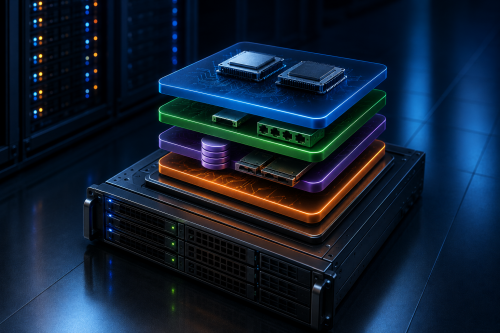
A server isn’t priced as “one machine”, but as a stack of parts that each have their own supply, demand, and margins. When there are issues with any one category, the whole server quote changes.
The core cost buckets
Compute
- CPU is the general-purpose brain. It runs the OS, applications, databases, and most enterprise workloads.
- GPU is a specialist processor for heavy parallel math (AI, training/inference, simulation, rendering). If your server includes GPUs, they will probably dominate the server price.
Memory (RAM / DRAM, and in AI servers also HBM)
- RAM (Random Access Memory)
The server’s main system memory (RAM sticks/DIMMs) that the CPU uses as its fast workspace for active data and running programs. It’s volatile – contents are lost when power is off. - DRAM (Dynamic RAM)
The most common type of RAM used as main system memory in servers and PCs (e.g., DDR4/DDR5). Its capacity and speed are critical for overall performance. - HBM (High Bandwidth Memory)
A special, very fast memory used mainly with GPUs and AI accelerators (and rarely with CPUs in specialized systems), designed for extremely high data throughput. It’s typically packaged very close to (or with) the GPU, not installed as normal DIMM sticks like server DRAM.
Storage (NVMe/SATA SSDs, HDDs)
- SSD (Solid-State Drive)
Storage with no moving parts (based on NAND flash memory). Much faster than HDDs, especially for random reads/writes. - NVMe SSD
A high-performance type of SSD that uses the NVMe protocol over PCIe (not the older SATA interface). Typically, the fastest option and most common in modern servers for databases, virtualization, and high-IO workloads. - SATA SSD
An SSD that uses the SATA interface (older, slower than NVMe, but still much faster than HDD). Often used when cost or compatibility matters, or for less performance-critical storage. - HDD (Hard Disk Drive)
Traditional spinning-disk storage. Slower, but cheap per terabyte – good for backups, archives, and large-capacity “bulk” storage.
Networking (NICs, cables, optics)
Networking is the data highway. It matters more as you scale: clusters, storage networks, east-west traffic inside the data center. In AI clusters, high-speed networking is essential for efficient scaling and performance, driving strong demand for specialized networking equipment.
Power + cooling (PSUs, fans, sometimes liquid cooling)
Power supplies aren’t discussed that often, but redundancy (dual PSUs) and efficiency matter for uptime and long-term energy cost. Higher-density systems (especially GPU servers) push power and cooling requirements up fast – sometimes forcing upgrades beyond the server itself (PDUs, rack power budget, cooling capacity).
The often-overlooked platform costs (chassis, management, support)
- Chassis + motherboard: the physical and electrical platform that determines what hardware you can install and how reliably the system operates.
- Remote management (BMC): lets admins control and recover systems remotely.
- Warranty/support: this is where “enterprise-grade” often lives – replacement parts, logistics, and response times cost real money.
Get the right infrastructure for your workloads
Why These Costs Are Moving More Than Usual
The simplest way to say it: AI demand is distorting the normal market. While they’re focused on GPUs, the ripple hits memory, storage, networking, power, and cooling – so even “regular” infrastructure projects start seeing price and lead-time surprises.
Reuters reported that NVIDIA’s H200 chips are being priced at roughly $27,000 per chip, and that Chinese tech firms have ordered over 2 million units for 2026 delivery. That kind of pull-through affects what server platforms get built, what configurations vendors prioritize, and how long it takes to secure complete systems.
Memory is where volatility becomes the most visible, because it’s both essential to “regular” servers and central to AI builds. There’s a significant tightening of traditional DRAM supply as production shifts toward AI-oriented chips. For example, DDR5 DRAM prices have risen by 314% from the 4th quarter of the previous year.
At the high end, high-bandwidth memory (HBM) has become a critical resource for AI accelerators, with suppliers competing for limited capacity in a highly concentrated market, with suppliers competing for NVIDIA-related business – Reuters noted Samsung discussing supplying HBM4 to Nvidia and highlighted how concentrated the HBM market is.
The result: even if you’re not building AI servers, you can still feel AI’s gravity in RAM pricing and lead times.
Storage
AI workloads also consume vast amounts of data, translating into increased demand for fast enterprise storage. TrendForce has repeatedly linked AI infrastructure expansion to stronger enterprise SSD demand and pricing; for example, it projected enterprise SSD pricing could rise up to 10% QoQ in periods where the market shifts toward undersupply.
On the supply side, there have also been sharp moves in NAND: NAND wafer contract prices jumped over 60% in November 2025 amid tightening supply and hyperscaler procurement for AI data centers.
In practice, storage volatility shows up as “the same capacity costs more,” or “the exact drive class we validated is suddenly harder to source at scale.”
Networking
AI clusters are network-hungry, and that puts pressure on high-speed networking and optics. 800GbE optics shipments were expected to grow by 60% in 2025, driven by hyperscale deployment inside and between data centers. Even if you’re building non-AI infrastructure, increased competition for high-speed networking gear can reduce availability and raise the cost of scaling out (especially in data-heavy environments).
Power and cooling
AI also changes the physics of the data center. Higher rack densities push power delivery and cooling from “facility background noise” to “design constraint.” Average rack power densities more than doubled – from 8 kW to 17 kW per rack over two years – and could rise toward 30 kW by 2027 as AI workloads increase. Analysts have also tied the rollout of NVIDIA’s GB200 rack-scale systems to accelerated adoption of liquid cooling in 2025. This is why a GPU-heavy deployment can force upgrades beyond the server itself: PDUs, rack power budgets, and cooling capacity become part of the “server cost,” whether you want them to be or not.
Сhassis, management, support
Because vendors bundle, substitute, and requalify around what they can actually ship – that can often change chassis availability, alter approved BOMs, and increase the value of enterprise support (faster replacement logistics, validated spare pools, and predictable response times). It’s also where “cheap now” can become “expensive later” if substitutions aren’t managed carefully.

How Organizations Are Affected
Let’s make this clear with examples.
A client plans a refresh of a virtualization cluster. The sizing is correct: CPU, storage, network are all fine. Then the quote changes and the delivery window stretches – because DDR5 availability decreases and pricing moves faster than procurement cycles. The deployment slips, and teams are forced into uncomfortable choices: delay the rollout, accept a partial delivery, or substitute components. Any of those options creates knock-on costs. Delays keep older hardware in service longer, which often means higher failure risk, more unplanned maintenance, and less predictable performance. Substitutions can invalidate earlier testing and force re-validation at the worst possible time – right before production. And when procurement has to re-quote midstream, budgets stop being budgets and start being moving targets.
A virtualization cluster is sensitive to balance. If memory becomes the constraint and the workaround is “less RAM for now” or “different modules that we can get quickly,” you can end up with hosts that look OK on paper but behave poorly under real load: swapping, latency spikes, and support tickets that weren’t supposed to exist. The business consequence is that users will feel it, and IT will spend time firefighting instead of shipping the next project.
Another example: a client comes in with a request: “We need GPU servers for an AI pilot.” The instinct is to treat that like any other purchase – pick a GPU, put it in a chassis, and ship. That approach fails because GPUs pull the entire platform behind them: power budgets jump, cooling requirements change, network architecture matters more, and memory becomes a first-order design constraint. Here, market volatility hits multiple layers at once. First, the GPU itself sits in the hottest part of the supply chain. Demand is intense, and availability can be shaped by both production capacity and export licensing. The U.S. government is still processing licenses for Nvidia’s H200 exports to China, with shipment timing uncertain – exactly the kind of factor that turns procurement into a moving target.
Then come the “attached” constraints. AI infrastructure has driven disproportionate demand for high-end memory – especially HBM, the high-bandwidth memory used in AI accelerators – leading chipmakers to prioritize HBM and reducing the supply of standard memory products. The Financial Times reported that soaring demand for HBM used in AI infrastructure is a major driver of chip shortages and broader price pressure across devices and components.
For the client, this creates volatility that turns into concrete project risk. If accelerator availability depends on export licensing, you can’t plan procurement like a normal supply chain – you’re forced into rolling timelines and conditional delivery dates. And even when GPUs are obtainable, the “attached” constraints can break predictability in less obvious ways. When chipmakers prioritize HBM for AI infrastructure, the supply of standard memory tightens and pricing jumps, which can force re-quotes mid-cycle or limit how quickly you can scale the cluster.
The end result is that an “AI pilot” can become harder to execute than expected, because the supply chain can force compromises: delayed start dates, staggered deliveries, or mixed configurations that complicate validation and performance baselining.
The common thread across both examples is the same: volatility doesn’t just change the price tag. It changes what vendors can commit to, what configurations can be delivered intact, and how much engineering discipline is required to keep a design stable while the supply chain moves underneath it.
Build custom infrastructure without supply-chain surprises
How We Can Help
Uncertainty is painful – and sometimes unacceptable – when you’re committing to a rollout date, a budget, and a performance target. This is where an experienced infrastructure solutions provider like Advanced Hosting can change outcomes.
First, we help with sourcing. When markets tighten, the difference between a one-off purchase and a real procurement channel is huge. Our vendor relationships help us secure better pricing and more realistic lead times, because we’re not approaching procurement as a single transaction but working through established supply paths that are built for constraint.
Second, we have the inventory. In volatile markets, deployments rarely fail because everything is unavailable; they fail because one critical component becomes a blocker. We keep stock specifically to address that risk. If a client needs capacity immediately, we can often provide whats required either as the final configuration or as a temporary bridge while long-lead components arrive. This approach is especially important when memory or accelerators are the bottleneck, as these components are under the strongest pressure from AI-driven demand.
Third, we protect the design from “substitution chaos.” Market volatility forces change – different memory SKUs, different SSDs, different NICs, different platform availability. The risk is letting procurement decisions quietly rewrite architecture. Our role is to keep the solution aligned with the workload translating business and performance requirements into a validated configuration, qualifying safe alternatives in advance, and managing substitutions so they dont introduce performance regressions or operational debt later.
Finally, we can deliver a working system – not a pile of parts. In a stable market, you can sometimes treat hardware as a commodity and patch the rest together. In the current environment, that approach costs time and creates risk. We design, build, and implement complete custom infrastructure solutions that match the workload – virtualization, storage-heavy platforms, or GPU-accelerated environments. Clients don’t just receive servers; they receive usable, production-ready capacity.
That’s the value in plain terms: better access, fewer delays, controlled substitutions, and infrastructure that fits what you actually run.