Log in

AI summary
The article discusses the architectural decision between using regular cloud services and bare metal servers, highlighting how this choice affects performance, scalability, operational complexity, and cost predictability. Organizations often start with cloud solutions for their speed and ease of use but may transition to bare metal for improved latency, throughput, and cost management. Bare metal servers are physical machines that run directly on hardware without a hypervisor, offering more control and stability, particularly for high-performance workloads. However, they come with operational responsibilities and less elasticity compared to cloud solutions. The article emphasizes that the best approach is often a hybrid model, utilizing both cloud and bare metal resources based on specific workload requirements.
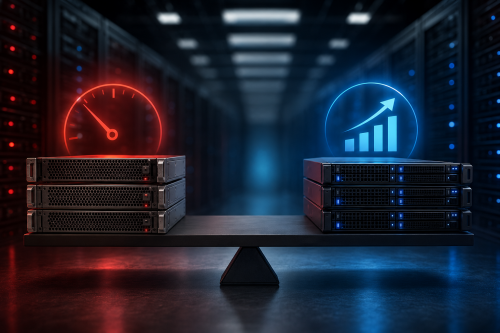
Choosing between regular cloud vs bare metal is an architectural decision. The model an organization selects influences performance under load, scaling behavior, operational complexity, and how predictable infrastructure costs remain over time.
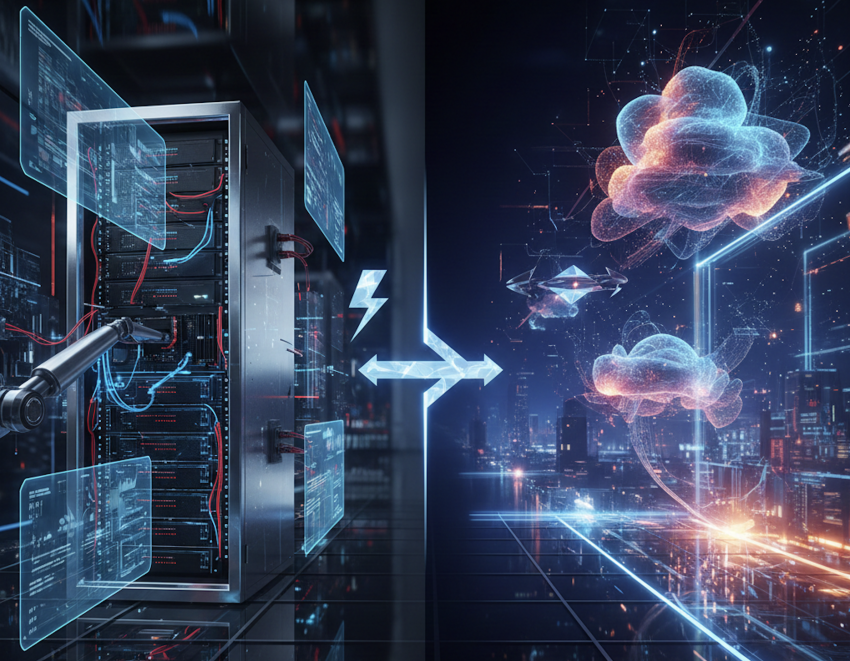
Many teams start out with standard cloud offerings because they move fast: provisioning is instant, services are readily available, and experimentation is easy. Others shift toward bare metal when latency, throughput, compliance boundaries, or cost predictability become more important than elasticity.
Some choose dedicated servers, with more access to data center hardware. For these companies, stability and control are the most important considerations. In practice, many mature environments become hybrid by design, placing different workloads on the infrastructure model that suits them best.
This article compares cloud, virtual, and dedicated servers as operating models – reviewing the strengths and trade-offs.
What is a Bare Metal Server?
Bare metal servers are physical machines that provide resource access to CPU, memory, storage, and networking. They run an operating system directly on the hardware and, by default, have no hypervisor layer between the workload and the server. Yet, they’re always a part of some larger infrastructure – that’s one of the most common definitions.
The underlying technology is the same class of data center hardware as a dedicated server: a real machine reserved for a tenant. But integrated into an ecosystem.
“Bare metal” is often used to describe physical servers delivered as part of an IaaS-style server infrastructure: integrated provisioning, unified management, monitoring, and network controls. And bare metal cloud computing typically denotes the same thing – the hardware that stays physical, but the surrounding platform is cloud-like.
For organizations comparing the differences, this is a useful mental model: cloud hides the hardware behind virtual machines and managed services; bare metal is a part of IaaS that exposes the hardware and gives hardware-level control, while still allowing cloud-like integration. A dedicated server is a standalone, complete product that gives you full access to the hardware.
Is Bare Metal Cheaper Than Cloud?
Sometimes. It depends on how the workload behaves.
Cloud pricing is consumption-based and tends to work best for variable demand: environments that need rapid experimentation, short-lived capacity, or frequent scaling events. Bare metal often looks better when demand is steady and always-on – high-performance workloads that run 24/7 with predictable baselines, where fixed capacity and predictable infrastructure translate into logical, predictable spend.
On the cloud, when a workload is stable and continuous, paying per hour plus storage operations and bandwidth can become too expensive over time. With bare metal (or dedicated servers), the cost model is simpler and easier to forecast.
Bare metal also avoids performance variability introduced by virtual machines. That does not mean it is “faster than dedicated” (the tech is the same); it means bare metal performance is deterministic by design, and the economics often improve when that determinism is required all day, every day.
What are the Disadvantages of Bare Metal?
Bare metal is powerful precisely because it removes abstraction. The disadvantages come from what that implies operationally.
First, it is less elastic by default. Cloud platforms can add capacity quickly from pooled resources. Bare metal scaling usually means adding nodes deliberately, which may introduce lead time and architectural decisions.
Second, control comes with responsibility. You’re effectively owning more of the stack: OS choices, patching strategy, tuning, observability, and failure handling – unless those operational layers are delivered as part of a platform.
Third, “bare metal” is not delivered the same way everywhere. Some providers offer bare metal inside a cloud-like ecosystem (integrated networking, unified monitoring, automated provisioning). Others deliver the metal servers as standalone machines, where everything beyond power, connectivity, and a server that boots becomes engineering work.
For teams weighing cloud vs virtual server options, this is the trade-off: virtual servers are easy to spin up but inherit hypervisor and variability; bare metal removes those layers but expects clearer intent about architecture and operations.
Is Bare Metal More Cost-Effective?
Often, yes – but “cost-effective” is not the same as “cheap.” It includes performance stability, operational overhead, and how predictable the environment remains as the system scales.
Bare metal typically becomes the logical cost-effective choice when:
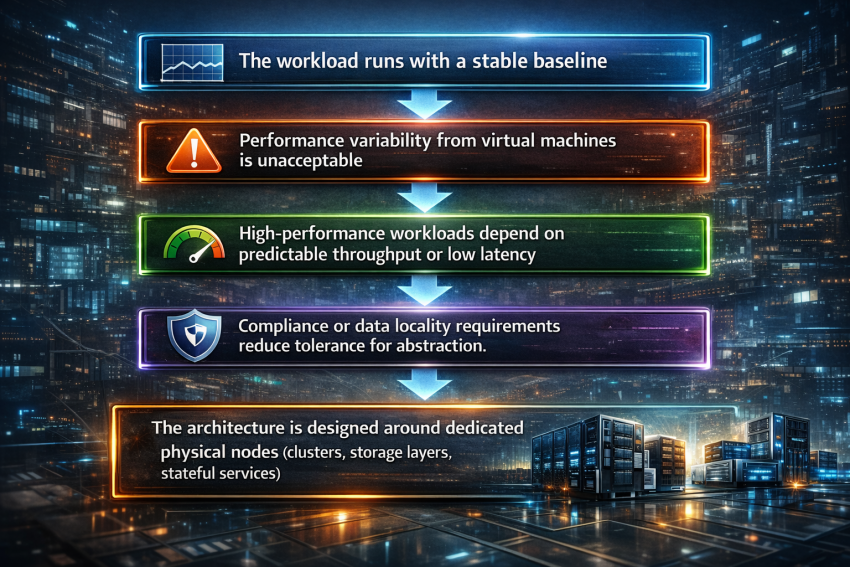
Cloud can still be more cost-effective when managed services replace engineering effort, or when demand is unpredictable enough that owning fixed capacity would create waste. That being said, many mature designs mix both models to get the best of both worlds: cloud for elasticity and platform services, bare metal for the workloads that demand deterministic performance and stable economics.
What Does Bare Metal Mean in Cloud?
It usually just means a physical server delivered through cloud-style operations. The machine is still a single-tenant server running an operating system directly on the hardware, but it is managed as part of an IaaS environment: provisioned through automation, monitored centrally, and integrated into platform networking and service layers.
The phrase does not mean “cloud on top of hardware” in the abstract – cloud is always on hardware. It means a specific operating model where metal servers are treated as programmable infrastructure resources rather than isolated boxes. In other words, bare metal cloud hosting is physical compute offered with a cloud-like control plane around it.
The contrast is easiest to understand by looking at what sits between the workload and the hardware:
- In most cloud computing models, workloads run inside virtual machines, with a hypervisor layer providing isolation and resource scheduling.
- In bare metal, that hypervisor layer is typically removed for the bare metal node itself, while the surrounding environment can still provide cloud capabilities such as unified management, network integration, and automation.
This also clarifies a common confusion about the difference between cloud computing and server infrastructure. The former emphasizes abstraction, pooling, and managed services. The latter emphasizes dedicated physical capacity with cloud-like operations around it – especially useful when certain workloads need hardware-level control, predictable infrastructure behavior, and full resource access, but still need to participate in a larger architecture.
Bare-Metal Server vs Cloud Server vs On-Prem Server?
These three options are often compared as if they were interchangeable. They are not. Each represents a different balance of control, abstraction, and operational responsibility.
A bare-metal server, as discussed, is a single-tenant physical machine with resource access. It runs the operating system directly on the hardware and avoids the hypervisor layer between the workload and the server. In cloud bare metal models, that physical server is still integrated into a broader platform, so it behaves like part of an IaaS environment while retaining hardware-level control.
A cloud server is typically a virtual machine delivered through a cloud control plane. This is where terms like virtual server vs cloud server create confusion: in many providers, the “cloud server” is a VM, but the real value comes from everything around it – software-defined networking, APIs, autoscaling, load balancers, managed databases, and object storage. The trade-off is abstraction: cloud reduces the need to manage infrastructure details, but it also reduces hardware visibility and can introduce performance variability tied to virtualization and multi-tenant behavior.
An on-prem server is physical hardware owned or directly controlled within an organization’s facilities. It provides the highest degree of sovereignty and customization, but also the highest operational burden: procurement, lifecycle management, spares, facilities, and staffing. On-prem can be excellent for strict compliance or legacy constraints, but it shifts responsibility for data center services and reliability engineering to the organization.
When to Choose a Bare-Metal Cloud?
A bare-metal cloud is a strong fit when physical compute is required, but operating servers one-by-one no longer scales. It is the middle ground between “an actual server” and fully abstracted cloud computing: dedicated capacity with cloud-like operations.
This model is typically chosen when certain workloads must run on single-tenant hardware for performance, compliance, or predictability – yet still need to be managed as part of a larger system. In other words, the architecture demands bare metal, and the operations demand cloud-style integration.
Common situations where bare metal makes sense:
- Databases, data processing pipelines, streaming components, and latency-sensitive services benefit from deterministic behavior and full resource access.
- When virtual machines introduce inconsistent I/O, moving specific components to bare-metal cloud computing can stabilize performance.
- Clusters, storage layers, stateful services, and performance-sensitive distributed systems often require predictable infrastructure and explicit control over network and storage paths.
- Environments that need hardware-level control but centralized operation. Bare metal allows direct control over the operating system and server behavior, while the “cloud” part provides unified provisioning, monitoring, and network integration across fleets of servers.
- Private cloud builds and hybrid architectures. Bare metal frequently becomes the base layer for a private cloud host model, where physical nodes run specific workloads inside an overall architecture while still being managed through a common operational framework.
Build an infrastructure model that fits your workloads exactly
Drivers That Make Bare Metal the Logical Сhoice
Bare metal becomes the logical choice when “more abstraction” stops being helpful. The decision is usually triggered by friction that shows up in production – jitter, cost drift, operational bottlenecks, or limits on how much control the platform will give.
Here are the most common drivers, framed the way they appear in real systems (not as a checklist):
Performance becomes a reliability problem, not an optimization project.
When latency variance breaks SLAs, the debate shifts from “cloud vs bare metal” to “how do we remove variability?” Bare metal performance matters here because the workload runs directly on the hardware.
The architecture needs topology you can actually control.
Some systems are sensitive to where data lives and how traffic flows. In these designs, predictable infrastructure is the foundation. Bare metal (or cloud bare metal) is often used for the components where throughput, locality, and consistency matter most.
You need hardware-level control for the workload to behave correctly.
This is less about “tuning for speed” and more about owning the operating conditions: kernel parameters, network stack behavior, CPU pinning, storage layout, NIC selection, and deterministic resource access. When those factors matter, bare metal is chosen because it restores the ability to shape the environment instead of adapting to a platform’s defaults.
The cloud cost model stops matching the workload.
Always-on services tend to expose the gap between usage-based pricing and reality. Once a system runs at a stable baseline, the conversation often moves toward “cloud vs dedicated server cost” and whether fixed-capacity metal servers would be more predictable. If you need a middle ground: physical capacity with cloud-style operations, without turning everything into a manual server-by-server process – it might be time to shop bare metal servers.
Operations need a platform.
This is where bare metal diverges from “just a dedicated server.” A standalone dedicated server can be the right product when a single machine solves the problem. But when the system becomes a fleet – multiple nodes, shared networks, monitored as one environment – bare metal becomes more meaningful as a model because it is integrated and managed like infrastructure-as-a-service.
Conclusion
In the end, this whole debate is about fit.
Cloud computing is built to abstract infrastructure: it accelerates provisioning, enables fast iteration, and surrounds virtual machines with a powerful ecosystem of managed services. Bare metal delivers the same class of underlying compute as a dedicated server – physical data center hardware running an operating system directly – while emphasizing deterministic behavior, single-tenant setup, and hardware-level control. When delivered as part of the cloud services, it adds a cloud-like operating model around physical machines, making fleets manageable as part of modern server infrastructure.
The most practical approach is to stop treating this as a binary choice. Mature systems place workloads where they belong: cloud for elasticity and platform services, bare metal for high-performance workloads that need predictability, and dedicated servers when a standalone, fully packaged machine is the right product. The architecture comes first; the infrastructure model follows.
Advanced Hosting is both a dedicated and bare metal server provider. We can deliver machines as standalone capacity or as part of a broader infrastructure model, including private cloud host designs. If you’d like to explore custom infrastructure options explicitly designed for your workloads, contact us.