Log in


AI summary
The article discusses the evolution of data center colocation, highlighting the shift from traditional models to modern infrastructure demands. It emphasizes that legacy colocation setups are increasingly inadequate due to rising complexities in power, cooling, and network requirements driven by advanced technologies like AI and SaaS. The core message is that effective colocation must integrate engineering solutions that address high-density configurations, ensuring stability and predictability in operations. Additionally, it outlines the importance of balancing control and operational responsibilities between providers and clients, advocating for a collaborative approach in designing and managing infrastructure. Ultimately, the article posits that successful colocation is not merely about providing space and power, but about creating a tailored, efficient environment that supports growth and innovation.
Data center colocation used to be a simple deal. The operator leased you rack space or even an entire rack, guaranteed and provided power and cooling; you brought your servers, connected them, and used the services under a predictable and simple SLA. Back when workloads were static, architecture was monolithic, and “availability” was the only important metric, this model was a win-win for everyone.
But infrastructure is no longer that easy. Modern platforms – streaming services, AI clusters, SaaS solutions with high levels of compliance with constantly changing regulatory requirements – are setting new trends. More density and power capabilities, minimal latency, and multisite connectivity that are diverse and redundant. These requirements don’t fit into the old definition of “rack and power.”
Legacy setups are quickly revealing their limitations. Power, cooling, network scaling, and SLA gray areas -these and other challenges of standard colocation create barriers for your business.
At Advanced Hosting, we’ve experienced this shift. We work with companies that have outgrown standard hosting, and instead of mindlessly scaling, we help them meet their increasingly complex infrastructure requirements.
Hidden Vulnerabilities of Standard Colocation
The challenges of standard colocation are too many to list exhaustively, so we’ll limit ourselves to the most common ones and explain the solutions we offer.
Digging deeper into the basics, it’s important to understand: delivering power to a rack to ensure stable equipment operation is, first and foremost, an engineering challenge limited by physics. Most legacy setups were designed 15-20 years ago, when the market didn’t anticipate racks consuming 20, 40, or even 60+ kW. Standards were different back then, and engineering was logically designed for the typical loads of the time.
Therefore, traditional colocation facilities often feature racks with single-phase 230 V and 16 A power supplies, providing a maximum of 5-6 kW per rack. Providers typically cap usable power at around 80% of that to ensure safety and stability. However, power is only half the story: such racks and rows are not designed to handle the amount of heat generated by a dense load – you can’t fool physics, and engineering must stay ahead of the urge to add more servers.
We’ve faced these limitations during our projects, so we’re consistently redesigning legacy sites while implementing modern approaches in all new locations. The key idea is simple: for high-density configurations, the engineering infrastructure must be designed to handle the corresponding thermal and electrical loads.
Therefore, we use high-power three-phase power feeds (400 V/32 A), higher-performance circuits, and increased cable cross-sections. At the same time, we maintain a PUE (Power Usage Effectiveness) reserve.
Cooling is a separate aspect. Modern design requires a conscious balance: we reduce the amount of “conditionally useful” space while ensuring the correct operation of high-load racks. In other words, space is used more efficiently: fewer square meters, but more available power and guaranteed cooling capability.
The ultimate benefit for the client isn’t that “we have three-phase feeds,” but that:
- The rack can actually consume the stated power.
- The cooling system is pre-designed for such thermal loads.
- The infrastructure remains stable and predictable at high density.
- Growth can be planned without the risk of running into hidden engineering limitations.
We don’t try to stand out with operational beauty, colorful cables, or even power distribution units; we realistically assess the situation and follow industry best practices to ensure real, not nominal, high density.
Get a private topology tailored to your application’s actual needs
Control and Operational Responsibilities: An Important Balance to Keep in Mind
One of the key advantages of any colocation is the high level of control: proprietary equipment, proprietary configuration, and proprietary processes. This truly opens up more opportunities. However, with this control comes a host of operational challenges that must be considered.
Procurement and Logistics: In the common colocation model, responsibility for equipment lies with the client. This includes:
- Selecting and purchasing servers;
- Interacting with suppliers;
- Coordinating deliveries and on-site deliveries;
- Handling warranty claims.
The provider typically provides access and infrastructure, but does not handle procurement or logistics. As a result, some of these tasks may fall to your engineering teams, increasing the operational burden and requiring additional resources.
Migrations: Complexity Requiring Planning
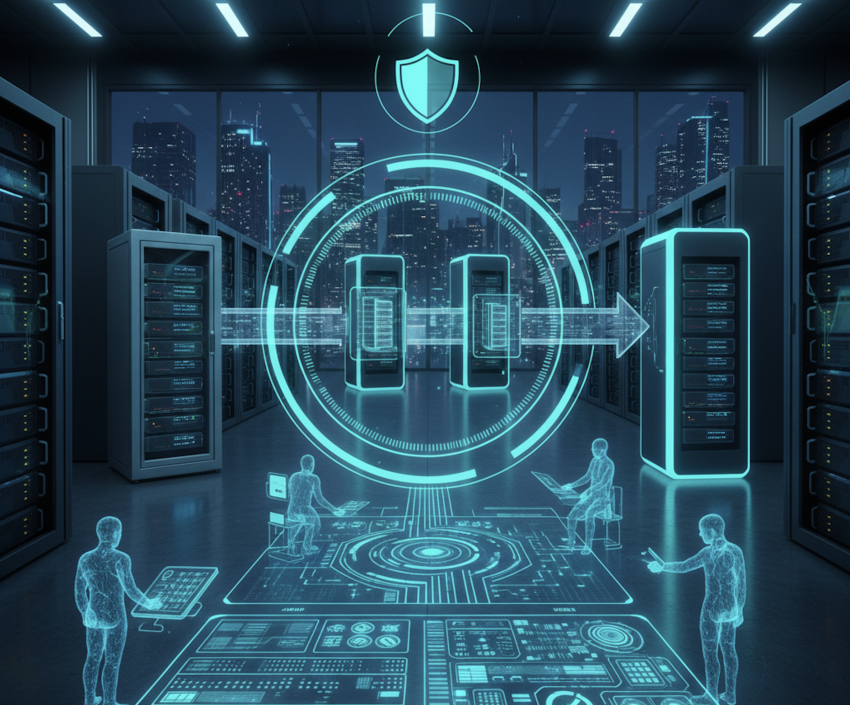
Moving infrastructure between sites is truly a critical operation. It requires precise preparation, phasing, and risk assessment. Standard colocation services provide the infrastructure base, but don’t always include methodological materials, personnel, or migration consulting support.
Responsibilities: Understanding SLA’s
In colocation, SLA boundaries are usually clearly defined:
- the provider is responsible for the power supply to the rack,
- for the operation of the network infrastructure up to the transfer point,
- for physical security and access.
Everything related to the client’s equipment – its configuration, component failures, and the rack’s internal network – is the client’s responsibility. This isn’t a drawback, but a standard model that’s important to consider to minimize delays and properly plan operations.
Financial Model
Colocation truly does provide stable and predictable monthly infrastructure costs. However, the total cost of ownership also includes additional factors:
- operational resources for equipment maintenance,
- depreciation and upgrades of equipment,
- RMA.
Colocation provides a high level of control, but also implies greater client involvement in operational processes. This is just a standard model. To maximize benefits, it’s important to balance the freedom to manage your infrastructure with the need to commit resources to its maintenance.
What a Modern Colocation Partner Should Actually Do
The level of difficulty and value of the work should define what the cooperation model should be. Based on years of experience working with clients at the intersection of their needs and market opportunities, we believe the solution isn’t “more racks,” but a more thoughtful architecture.
Here’s what we think modern colocation should look like:
1. Architect With You, Not Just Host You
A provider’s work shouldn’t end at the door. Rack design, power distribution planning, and airflow optimization are what make the difference between “working” and “not working.” Modern colocation should include architectural guidance.
2. Deliver Infrastructure as a Project
Procurement, logistics, and warranty service are not a luxury, but a necessity. When customers can outsource these pain points to their colocation partner, their own teams can focus on applications and business results.
3. Think in Hybrid Terms
Not every workload should be hosted in the cloud, and not every rack is customer-owned. A modern hosting provider must support mixed models:
- hosting customer-owned equipment,
- provider-leased bare metal or private cloud,
- network fabrics that connect all together.
Flexibility in capital and operational expenditure models is often a deciding factor for CFOs, not CTOs
4. Build for Density
The words “high-density ready” on a website aren’t enough. Real density requires real power allocation and cooling strategies tailored to each site. This must be proof of engineering maturity, not just marketing.
5. Transparency and Autonomy
If customers can’t see or manage their infrastructure remotely, it’s not enterprise-ready.
See why colocation works best when power, cooling, and network are engineered together
The Bottom Line – Colocation Without Architecture Is Just Storage
Standard colocation delivers what it promises: space to house servers, power to run them, and cooling to prevent overheating. This is a necessary foundation – but it’s no longer sufficient.
Modern infrastructure is not efficient in isolation. It’s efficient when capacity, cooling, and space are designed as a unified system. In this approach, high density is not a constraint but a pre-planned scenario. This balance of engineering and operational maturity allows the infrastructure to operate predictably and scale without hidden risks.
Without that, colocation becomes nothing more than storage with a standard/flat SLA.
The next era of colocation belongs to providers who treat infrastructure not as real estate, but as a complex solution developed for specific needs and have room for expansion for the next years ahead. Partners who don’t just sell racks, but design environments that absorb growth.
That’s the philosophy we’ve built at Advanced Hosting: colocation as an engineering discipline. Because in 2025, the companies that win are those with the smartest, most optimized infrastructure.
Discover how a properly engineered colocation setup can change your operations.